


Something is off and you cannot name it.
Your output is faster than it has ever been. Your folders are organized. Your agents have names. The work that used to take a day takes an hour. And quietly, in a place you do not talk about on LinkedIn, you suspect it is still generic.
It reads competent. It reads on-brand. It also reads like it could have come from any other operator in your space who built the same folder system this quarter. You thought the architecture was the answer. The architecture is built. The output is still drift.
You do not know what is missing. You do not know what to ask for. You are not behind. You are standing in front of a piano.
The piano in the house
A lot of people had a piano in the house growing up. Very few of them could play it.
We had one too. It sat in the front room of my parents’ house for years. The instrument was there. The bench was there. The lid opened. The keys worked. None of that made anyone in my family a musician.
I was a senior in high school the night I figured out what a piano was actually for. A few of us had come back to my friend Scott’s house after closing down the pizza place where one of the guys worked. We had custom pizzas and cans of Coke and nowhere to be. Scott sat down at his family’s piano and started playing the theme song to Cheers. None of us knew he could play. A roomful of teenage boys on a Saturday night, singing where everybody knows your name. He never played for us again. I have never forgotten it.
The instrument had been in his house his whole life. The instrument was not the music. Scott was the music. The piano was just what let him give it to us.
This is the part of the AI conversation almost nobody is having.
The folder system is the piano. The orchestrator, the specialists, the file routing, the persistent memory. All of it is the instrument. It is real. It is capable. It is sitting in your office right now if you got to Level 4.
The score is what you play on it. The score is the doctrine. The score is the set of beliefs and operating rules your agents are protecting every time they produce work. Without the score, the instrument is furniture. Beautiful furniture. Expensive furniture. Furniture all the same.
The ICM is the instrument. Doctrine is the score.
That is the line the rest of this piece pivots on. I want you to feel it before I name it again.
Why your SOPs are not the score
Here is where most of the operators reading this are going to nod and close the tab. I already do this. I have my SOPs loaded into the project.
You do not. And the distinction is the whole conversation.
Picture two agents sitting next to each other. Same model. Same architecture. Same access to the same CRM. The prospect on the screen is a name you have been chasing for three weeks. The qualification call just ended. The agent’s job is to draft the follow-up.
The first agent has your SOPs loaded. Subject line formulas. Paragraph cadence. The opener you like. The signature you use. The constraint that says no em dashes and no exclamation points. The agent writes a clean follow-up in your voice. It is on-brand. It is the right length. It would pass any per-asset review you put it through.
The second agent has your SOPs loaded too. And underneath those SOPs, it has your doctrine. The rule that says we do not follow up on prospects who failed the qualification frame. The rule that says we do not deepen relationships that violate the ICP, no matter how warm the conversation felt. The rule that says a beautifully written wrong move is more expensive than a missed one, because it commits us to a customer the system was built to refuse.
The second agent reads the call notes and stops. It does not draft. It surfaces a flag instead. This one failed the frame. The follow-up the SOP is about to fire would deepen the wrong relationship. Confirm before we proceed.
The first agent is skilled. The second agent is right.
SOPs tell the system how to do the work. Doctrine tells the system what the work is for, and which work is not worth doing at all.
Most operators stopped at the first agent and called the job done. The output looked good. The output kept coming. They never noticed the system had no opinion about whether the output should exist. SOPs make the agents skilled. Doctrine makes them right.
What took me a decade to see
I did not know I had been building it.
For thirteen years I sat inside paid media campaigns. I watched ad accounts and CRMs and the gap between what marketing promised and what sales actually closed. I wrote diagnoses. I made calls about what to fix first.
I don’t remember the client. I remember the feeling. I was walking through another account, another CRM gap, another campaign that looked busy but wasn’t connected to revenue. Halfway through the diagnosis I realized I wasn’t deciding anymore. I was following an order.
The client had come to me for paid media. The one before had come for SEO. The one before that, the same. I had been taking the order and getting to work. I had stopped asking whether the order was the actual problem.
So I stopped. I started asking a different question instead. Do you know why your customer buys from you? And almost every time, the answer was no. Not a sharp no. The kind of no that sits in the air for a second while the person on the other side of the desk realizes they have been running a business for fifteen years on an answer they never wrote down.
That question became a rule. I do not take the order at face value anymore. Not paid media. Not SEO. Not the brief they walked in with. The brief is almost never the problem. The problem is upstream of the brief, and the operator usually does not know it yet.
It had been a rule the whole time. I had been treating it as judgment. It was doctrine. The repetition had been the proof. I had been the last one to notice.
That was when I started writing things down. Not framework names. Not slogans. The actual rules. Why diagnosis comes before tactics. Why no client gets a creative brief before the customer reality, measurement layer, and strategic constraint are clear. Why nothing leaves the building without governance. Why revenue has to be the number that eventually proves whether the work was real.
I never sat down to write a doctrine. I had been writing it for years and did not know. Seventy-five episodes of a podcast with my co-host Tom Nixon, talking with operators and clients and peers about the work. The beliefs spilled out in conversation. The vulnerabilities spilled out in conversation. The rules I had earned by repetition spilled out in conversation. None of it was organized. None of it was named.
Then I started mining the transcripts.
I dumped the episodes into AI and asked it to find the patterns. What I was looking for was content ideas. What I found was doctrine. The same rules I had been saying out loud to a microphone for three years. I had been the last one to hear them.
That is the part of this story I want you to sit with for a second. The doctrine was already there. AI did not generate it. AI revealed it. The amplifier the manifesto named two essays ago is not just an output amplifier. It is a recognition amplifier. It made me visible to myself.
Then I found the folder system.
I watched what people like Jake Van Clief were doing with persistent context and agent architecture, and the air left the room. I had spent a decade preparing for the moment I would have somewhere to put it.
Most operators are climbing the ladder in the opposite order. They are installing the instrument first. They are watching demos of other people’s pianos and buying the same model. The instrument arrives. They sit down. They realize they do not have anything to play.
The order matters. Context precedes architecture. The manifesto pointed at this. The 5 Levels mapped the climb. This piece names what you climb toward: a doctrine strong enough to become infrastructure.
The rules a system has to honor
There are three lines I keep coming back to. They are not slogans. They are the rules a system has to honor before it produces work worth shipping.
Coherence before creativity.
If your underlying logic does not line up, AI does not fix it. AI runs the incoherence at higher volume with better grammar. The manifesto named this. It is still true at Level 4. It will still be true at Level 10.
Diagnosis before tactics.
The glitch in a marketing system is almost never where the operator thinks it is. It is upstream. It is in how the customer is defined, or how the data flows, or how the story is told, or how the close-loop is wired. An agent told to write a better ad without a doctrine that demands diagnosis first will write a prettier version of the wrong thing.
Context before architecture.
This is the one this piece exists to name. The folder system is downstream. What lives inside the folders is upstream. If the upstream is empty, the downstream produces drift. If the upstream is sharp, the downstream produces leverage.
Three rules. Two of them earned the second appearance. The third earned the first.
Doctrine is not a brand guide. It is not a folder of examples. It is the operating law underneath the work. Who we serve. What we refuse. What must be true before we act. What proof matters. What the system is never allowed to optimize at the expense of the business.
What changes when the score shows up
There is an operator I am working with right now. Services business. Mid-market. Twenty plus years in. He read the manifesto. He read the 5 Levels. He showed up at Level 3 already.
He had agents. He had a folder system. He had done the climbing. He thought he had a marketing problem.
We ran the diagnostic. He did not have a marketing problem.
He had a sales problem.
The way he sold to a prospect was nothing like the way his team sold to the same prospect a week later. He sat down with people and listened. He took a pain inventory. He used no acronyms and no feature lists. He helped the prospect see the shape of the problem before he ever mentioned a service. By the end of a first meeting, the prospect felt understood in a way three other firms had not managed.
Then the handoff. His team would walk in with a feature list and a thirty-six-page proposal. The prospect who had just heard the owner help them think about their business would now be asked to read a document they could not read. My partner Tom Nixon named the pattern early. Selling simplicity, delivering complexity. The brand promise was being broken in the second meeting, every single time.
Deals were falling apart at the handoff. He did not know why until the diagnostic surfaced it.
He had been protecting the way he sold for twenty years. He had never written it down. None of it was protected. The agents he had stood up could not hold a register he had never named.
Now we are building the doctrine. Not the SOP for the follow-up email. The doctrine underneath the sales motion itself. What he listens for in the first ten minutes. The frame he uses to make the prospect’s situation make sense to them before he ever opens a deck. The reason he refuses to send a proposal in the first meeting. The reasons he walks away from deals his team would chase.
When the doctrine is written, his sales team will sell the way he sells. The agents will protect the way he sells. The handoff will stop bleeding.
Same instrument. Different output. The agents will not have changed. The score will have.
The architecture you have already seen
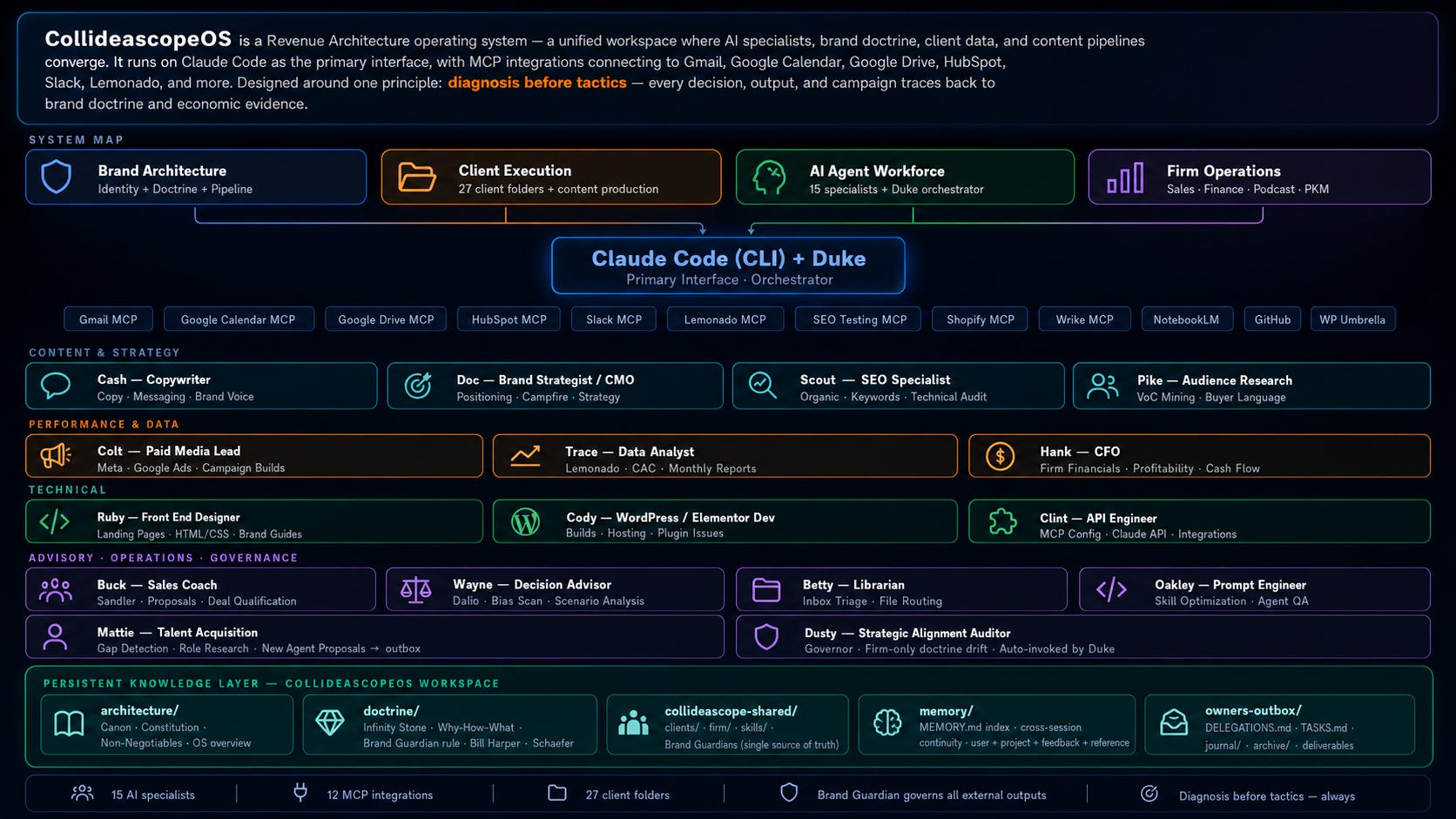
In my system, there is an orchestrator. There are specialists with defined roles, constraints, and judgment boundaries. There is a doctrine layer the team loads before producing. We call it the Brand Guardian. It is the operating law every specialist is held against. There is a verification step the producer is never allowed to close on its own work. There is a memory layer that stays human-readable so the next operator can open a file and understand exactly what was being protected.
The names matter less than the order. Mine has an orchestrator named Duke who routes the work before the work begins. The names are mine. The pattern is portable.
A note for the builders, because this is the part I have to clarify almost every time it comes up. The doctrine layer my team uses is one thing. The MCP I built is something else. The MCP is how I deliver doctrine into a client’s AI environment so their internal teams can produce work that holds the brand without my team in the room. Same doctrine. Different surface. The reason both live behind controlled layers is the same reason a coach does not hand his playbook to the opposing team. The doctrine is the asset. If I give it away, I give away the system that produced it.
The score is enforced at the door, not after the fact. The system assumes the producer is the worst auditor of the produced. The memory lives in folders, not in a vector database, so the doctrine stays readable to a human a year from now.
That is the instrument. None of it matters without the score.
What you actually climb toward
Most of the AI ladder discourse is about building more. More agents. More automations. More overnight workflows.
That is not the path. Or it is, but only after the harder path.
The harder path is naming what you have been protecting all along. Most operators have a doctrine in their head. They built it by repetition. They have never written it down. They are about to install an instrument and discover they do not know what to play.
Do not do that.
Most operators do not need more agents yet.
They need a score.
They need to name the rules they have already earned.
Then, and only then, they should build the system that protects them.
The strongest AI systems in the next few years will not belong to the operators with the fanciest orchestrators. They will belong to the operators with the clearest philosophy embedded inside them. Mark Schaefer has been saying a version of this for years. Technology amplifies what already exists. It does not replace the need for humanity, originality, or a point of view.
AI systems without doctrine will produce competent mediocrity at scale.
AI systems with doctrine will produce something nobody else can.
Coherence before creativity.
Diagnosis before tactics.
Context before architecture.
That is the system worth amplifying.
So I want to leave you with the question I had to ask myself before I knew there was a question.
If I cloned your stack tomorrow. Same agents. Same prompts. Same file structure. What would still make your work unmistakably yours?
If the answer is nothing, the work in front of you is not building more agents.
The work in front of you is naming the doctrine you have already earned.
Then go build the system that protects it.
Great stuff. To take this analogy one step further, if you truly want to impress people, play the song that YOU wrote…not somebody else’s song that people have heard a million times and can get anywhere anytime from anyone!