

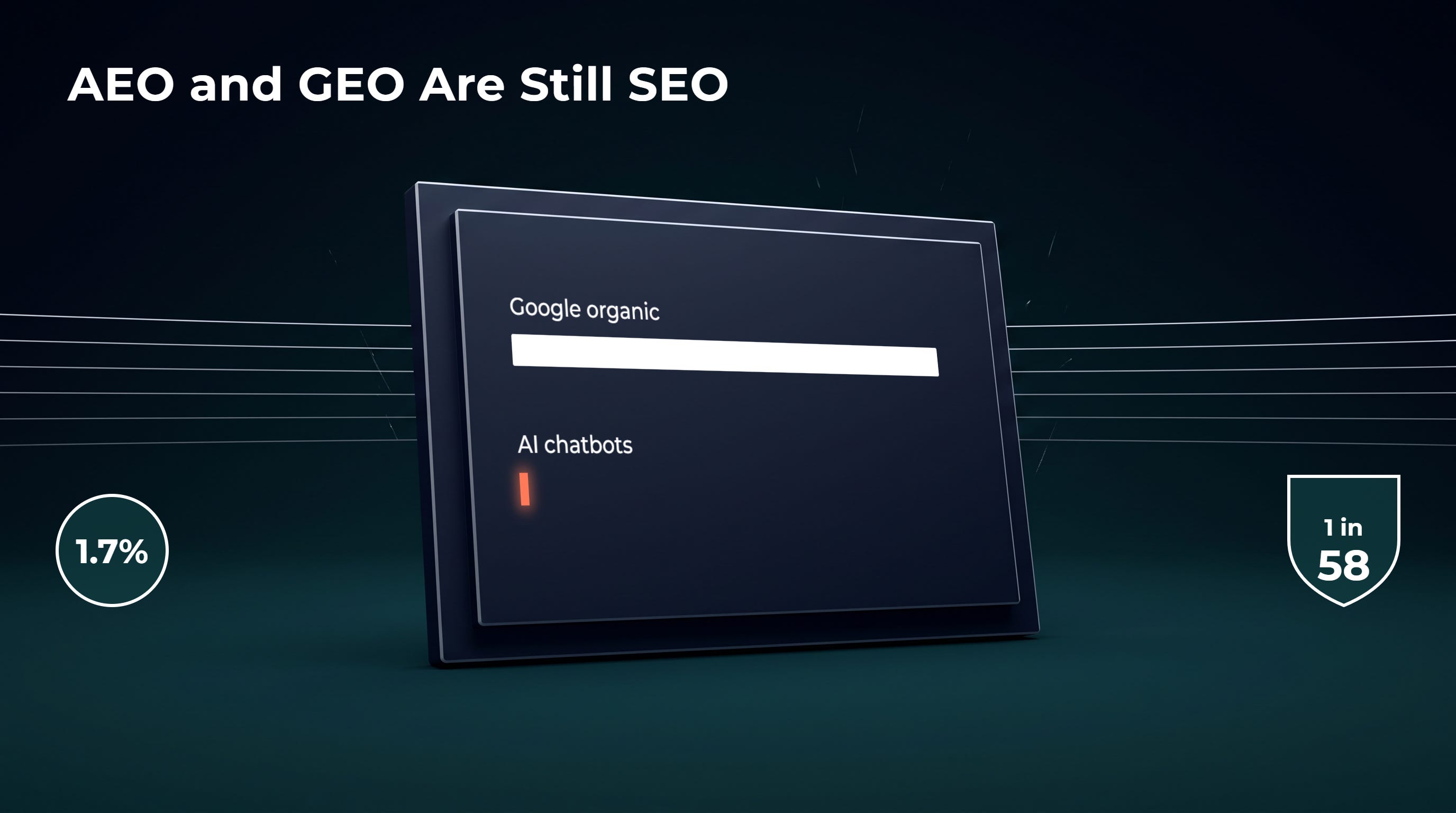
AEO is answer engine optimization. GEO is generative engine optimization. Both mean work aimed at getting your business mentioned in answers from tools like ChatGPT, Perplexity and Gemini.
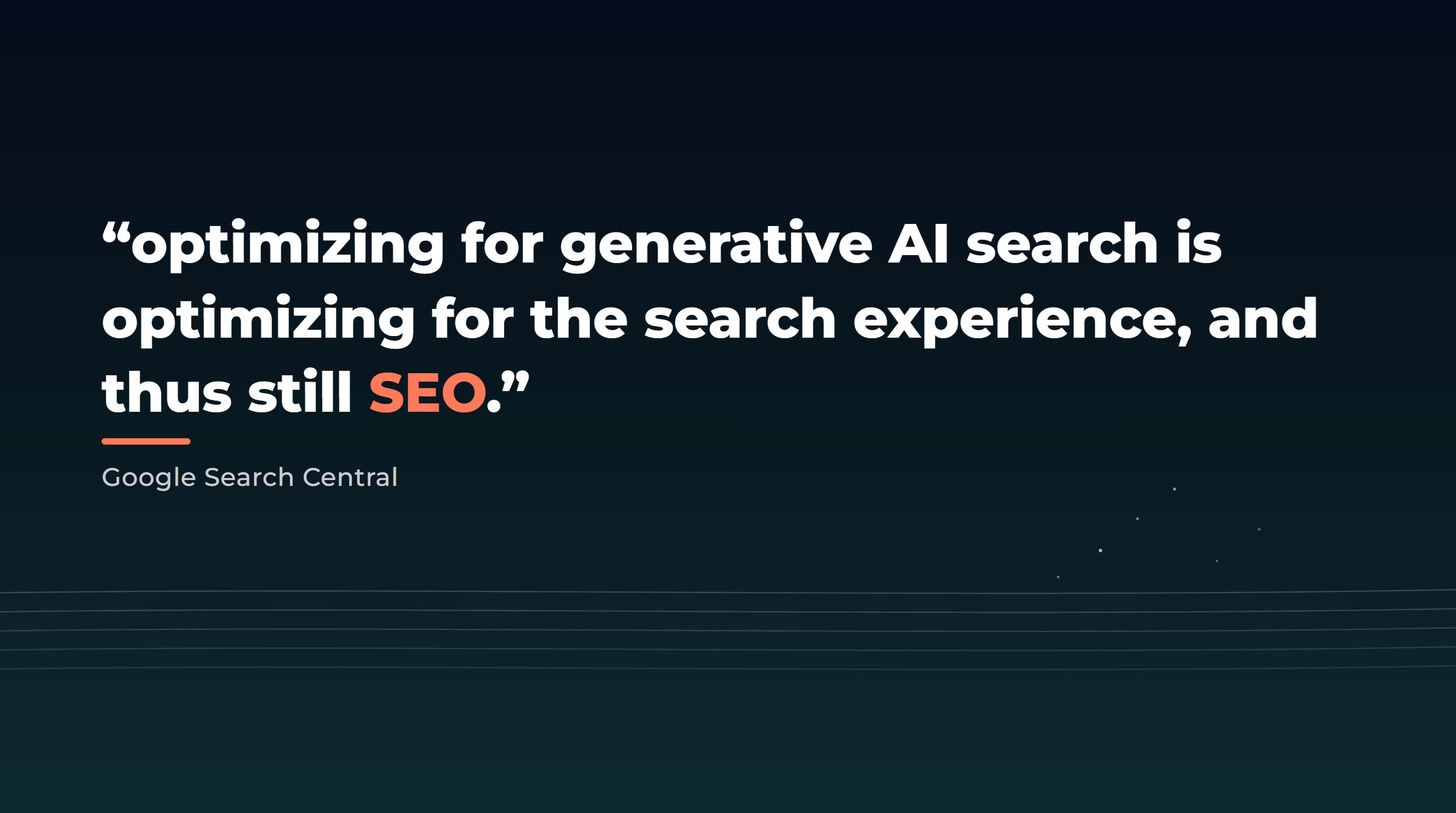
Google’s Search Central guide to optimizing for generative AI features says “optimizing for generative AI search is optimizing for the search experience, and thus still SEO.” The guide defines AEO and GEO as terms for work to improve visibility in AI search. The guide covers Google’s own AI features, not ChatGPT or Perplexity.
In my view, SEO work is real, and it sits inside search scope: schema markup, FAQs on your website, resource guides, a proper robots.txt and a proper sitemap, plus any backend work a site needs to be discoverable to any search engine.
I’ve done SEO for 13 years, so I’m not a neutral party on this question.
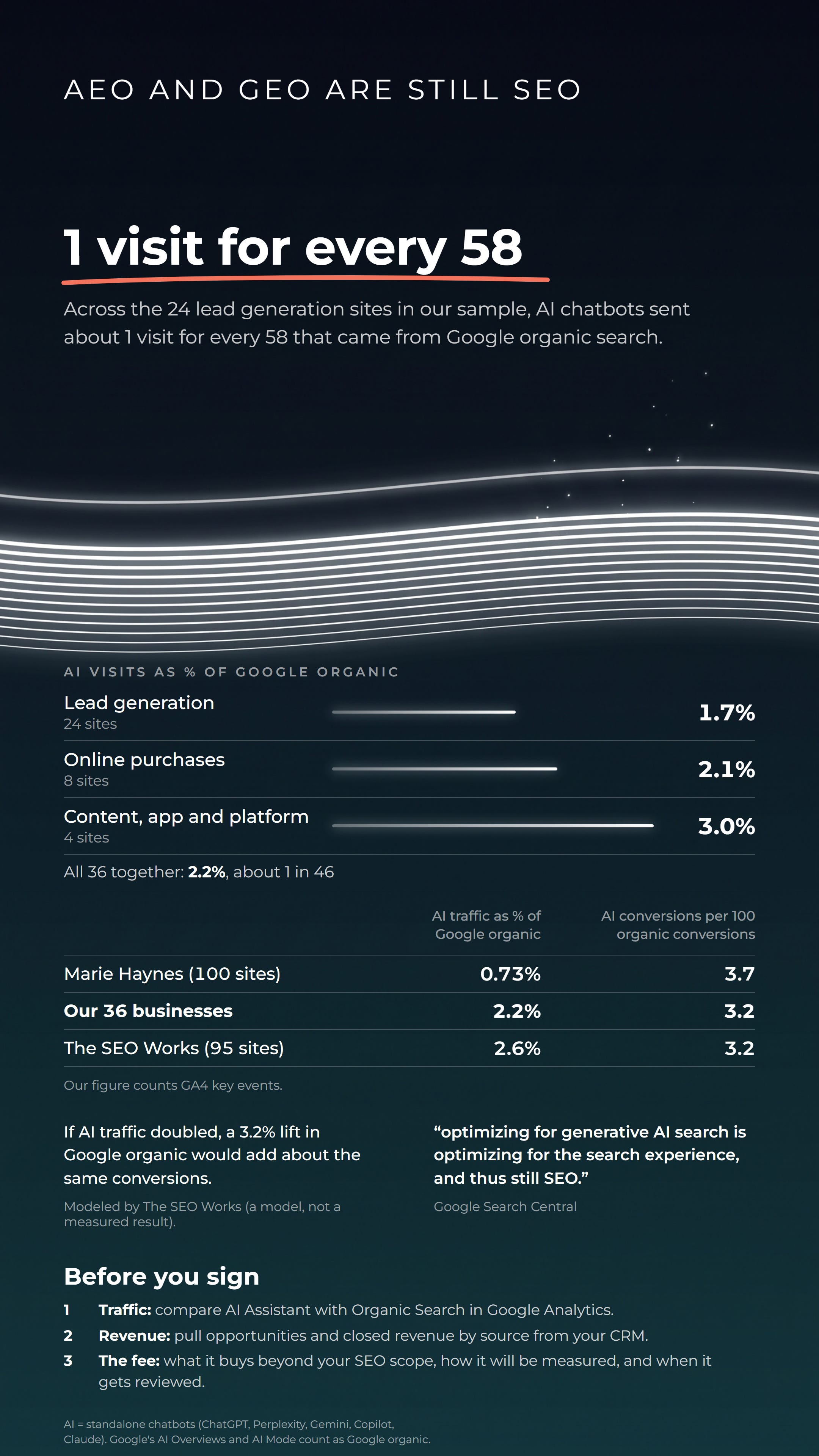
We took a sample across 24 lead generation sites among 36 businesses we work with and pulled 12 months of analytics for. AI Search platforms sent about 1 visit for every 58 that came from Google organic search. Across all 36 businesses, including online stores and content sites, it was about 1 in 46. None of the 36 businesses we work with bought a separately billed AEO or GEO program from us.
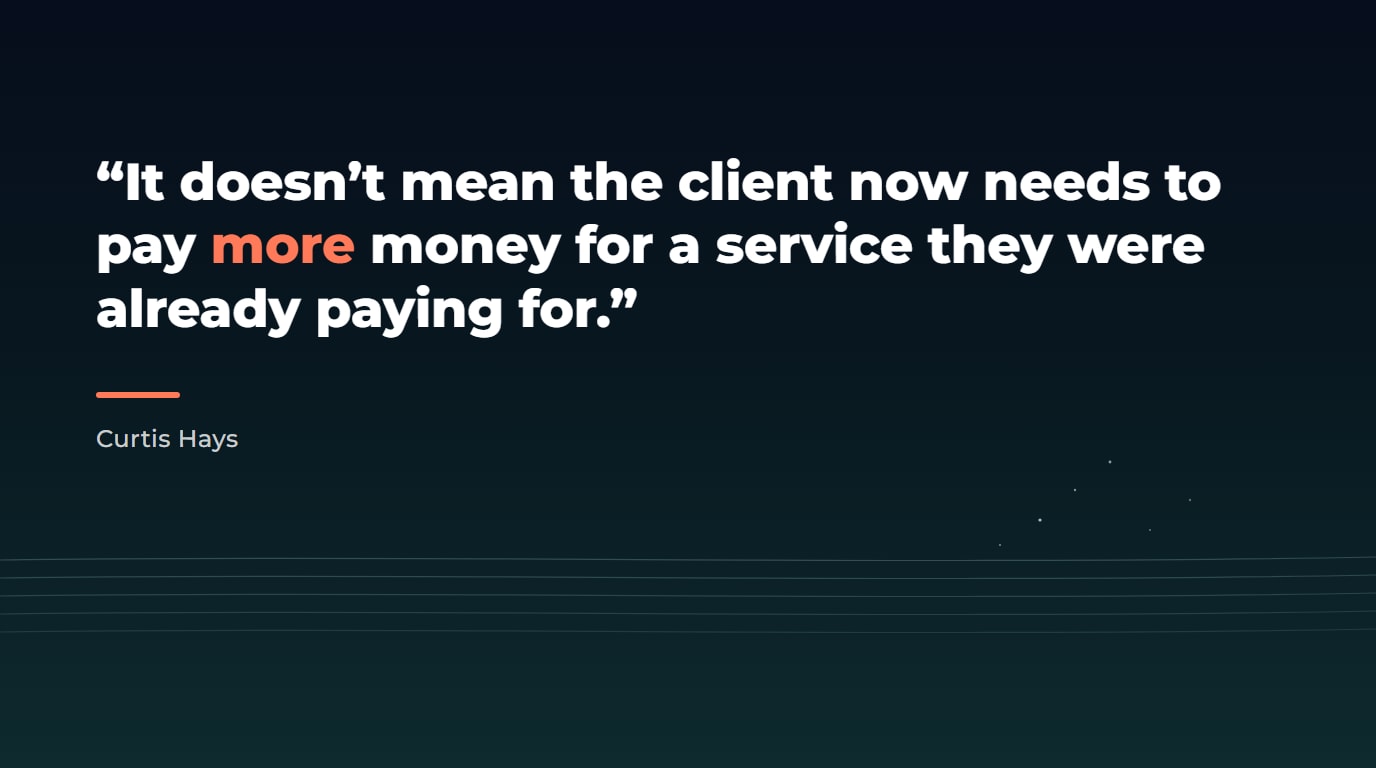
Say a client pays $1,000 a month for SEO, and a proposal adds another $1,000 a month for AEO or GEO. In the lead tracking for several of our local service clients, AI tools send about one lead a month or fewer. What would the second $1,000 buy that the SEO doesn’t already cover?
Why I doubted it from the start
I’ve been doing SEO for 13 years. In the last year or two I’ve seen AEO and GEO sold as separate monthly services by other agencies, on top of the SEO a client already pays for. To me it sounded like a new name for work that SEO already covers.
Prospects ask me whether I sell it. Clients ask me too. I tell all of them the same thing: it’s the same SEO work we’re already doing. The numbers below show what AI tools send us without a separate billable program.
GEO is a Distraction
Marie Haynes published “GEO is a distraction,” with 12 months of Google Analytics data from 100 sites. All the AI chatbots combined sent 0.73% as many sessions as Google organic. Across the 55 sites that tracked conversions, Google organic drove 964 and all the chatbots drove 36, about 3.7 for every 100. The other 45 sites tracked no conversions at all.
Lets Prove It
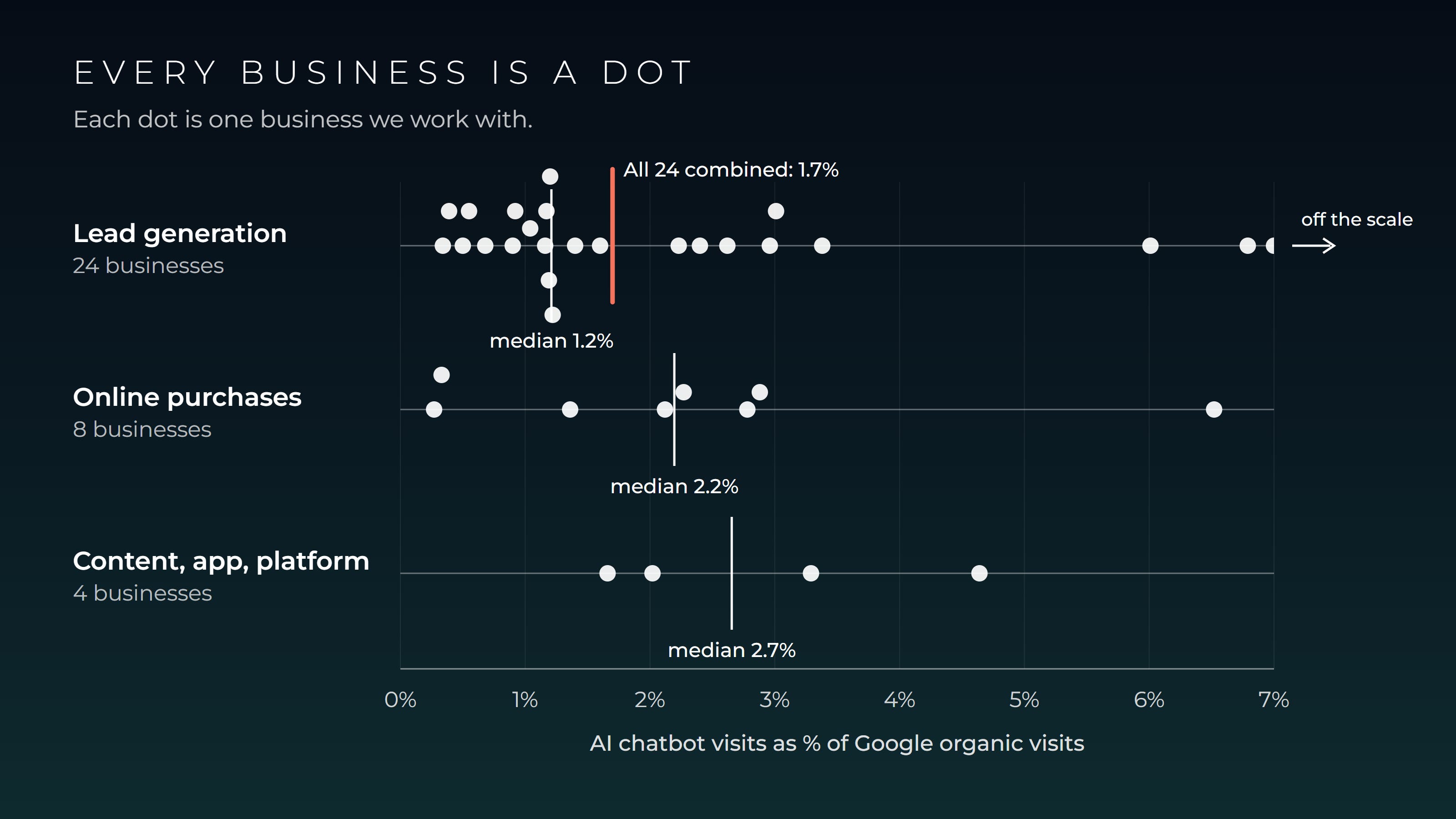
I agreed with her, so we pulled the same 12 months across 36 businesses we work with to see what our own data said. We sorted the 36 into three groups by rule: lead generation sites (24), sites where Google Analytics records online purchases (8), and content, app and platform sites (4).
AI chatbots we can identify sent the 24 lead generation sites 25,032 visits. Google organic sent 1,463,771. That’s 1.7%, or about 1 visit for every 58. The median business came in at 1.2%. Without the largest account, the share is 1.3%. Google Analytics counts clicks from Google’s own AI Overviews and AI Mode as organic search, so those sit in the Google number, not ours.
The 8 online purchase sites came in at 2.1%, or about 1 visit for every 49, with a median of 2.2%. Without the largest account in that group, the share is 1.7%. The 4 content, app and platform sites came in at 3.0%, or about 1 in 33, with a median of 2.7%. Across all 36 businesses, AI sent 68,162 visits against 3,142,856 from Google organic. That’s 2.2%, or about 1 in 46, with a median of 1.6%.
The lead generation sites’ AI visits produced 444 key events, against 9,357 from Google organic, or 4.8% as many. AI visits produce key events at roughly 2.8 times organic’s rate per visit, or about 1.9 times without the largest account. We’re working from a small base, and each site defines key events its own way. Buyer intent could explain the gap, or how one site tracks. We can’t tell. A key event is whatever a site marks as one, like a form fill or a call. Key events aren’t customers, and we didn’t trace these through to sales. Across all 36, AI key events were 3.2% of Google organic’s (3,711 against 116,309).
Bigger datasets show the industry growing. Ahrefs, looking at 115,254 sites, found ChatGPT referrals up 14.1% from August to September 2026.
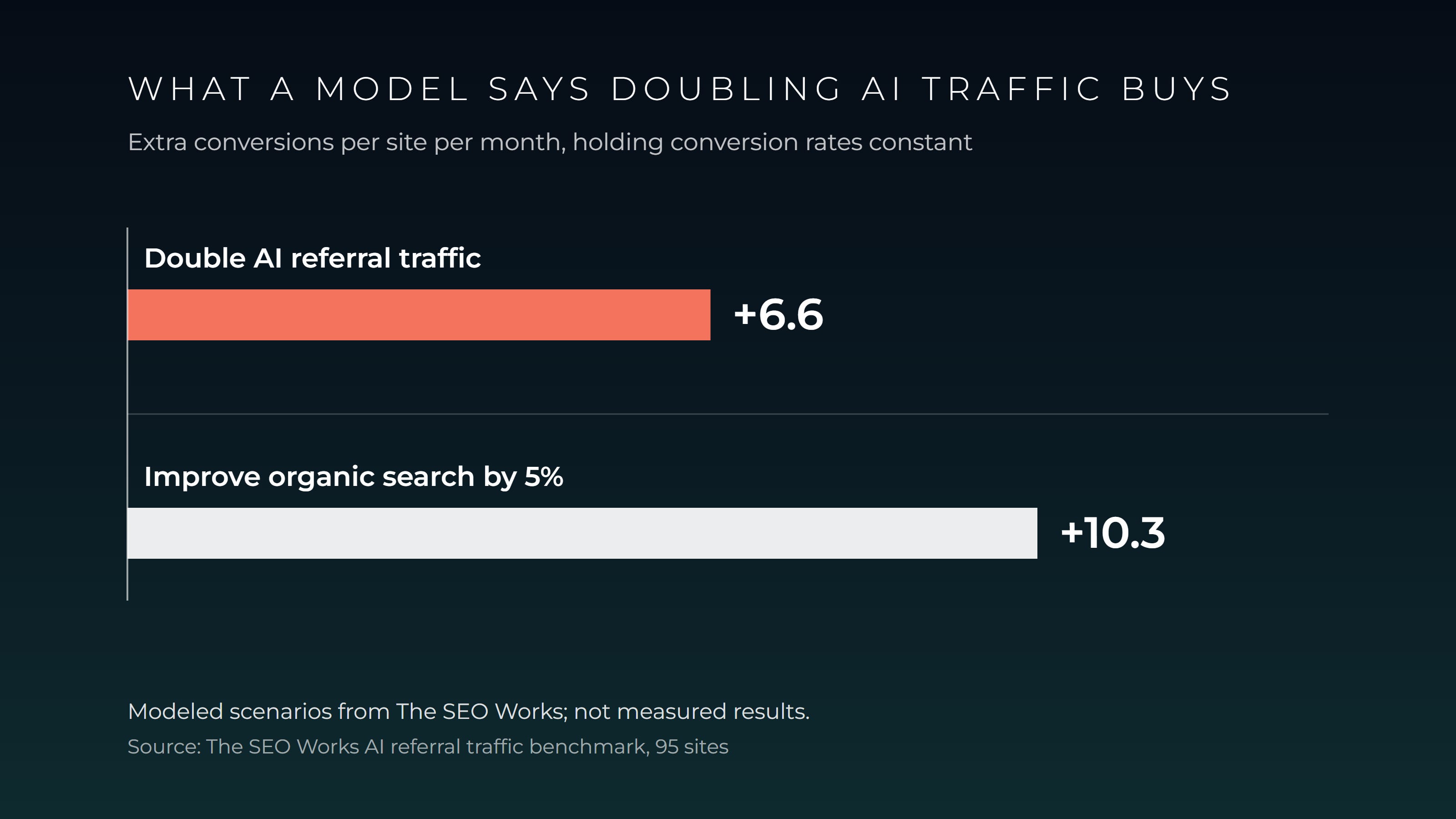
Outside numbers land in the same range as ours. The SEO Works benchmarked 95 sites and found AI at 2.6% of organic, with 3.2 AI conversions for every 100 from organic. Their model, which holds conversion rates constant, estimates that a 5% improvement in organic would add more conversions than doubling AI referral traffic.
None of the 36 businesses we work with bought a separately billed AEO or GEO program from us, and AI tools sent them visits anyway. Not all of them buy SEO from us, and some buy only paid media or site maintenance. I believe those visits came from site and content work these businesses already had, whoever did it. In our own scopes, work aimed at AI visibility sits inside the SEO scope and isn’t billed on its own line.
What this doesn’t tell you
It doesn’t show why AI referrals arrive, and it doesn’t tell you whether extra work would bring in more. Nobody in our set bought a separate program from us, and we don’t know what any of them buys from other vendors. That leaves nothing to compare a paid program against.
We counted clicks. Some AI research may end in a branded search on Google or a phone call, and some AI clicks arrive with no referrer and land in “direct.” Neither shows up as an AI visit, which puts our AI number below the true figure.
Your number depends on how your customers buy. In our set, local service businesses mostly ran under 2.5% of organic, with one at 3.0%. Of nine businesses that sell to other businesses, five ran between 3% and 7% of Google organic. Of the other four, one ran higher and three ran lower. If your buyers research for weeks before they call, expect a higher share than a local service business sees.
What lead tracking shows at six local clients
Over the same 12 months, our own lead tracking recorded calls and form fills for six of our local clients. Phone calls made up about 92%, 92%, 82%, 66%, 52% and 36% of their tracked leads. Calls were the majority at five of the six. AI tools’ share of tracked leads at those six ran from 0% to about 1.4% each, about 1 lead in 400 across all six together. Several of them get about one AI lead a month or fewer.
You need two numbers for your own business: how many of your leads are phone calls, and how many come from any AI source. Pull both from your call tracking or your CRM.
It’s search
SEO is real work. If I charged for AEO or GEO as its own monthly line, I’d be selling snake oil. Schema markup, FAQs on your website, resource guides, a proper robots.txt and a proper sitemap are SEO work. The three questions near the end ask for the difference in writing.
If a site needs backend work to be discoverable to any search engine, I tell the client plainly and fold it into the SEO and site work they already pay for.
Google’s guide, quoted at the top, also says “You don’t need to create new machine readable files, AI text files, markup, or Markdown to appear in Google Search.” Both quotes support my view within the limit stated above.
The case for building for agents now
Haynes makes the best case for paying now herself: prepare for AI agents that search and buy on a customer’s behalf, and she points to Google’s Universal Cart, the Universal Commerce Protocol (UCP) and WebMCP. She may be right that agentic commerce will matter a great deal.
Google launched Universal Cart on October 15, 2026, in the U.S. only. Its UCP checkout is an early-access pilot for select merchants, U.S. products only. Chrome’s WebMCP is “a proposed web standard,” in an origin trial, “under active discussion and subject to change.” I wouldn’t pay a recurring premium for infrastructure that’s still in pilot. If you want to prepare, scope it as a project with an end date.
What would justify paying extra
If you buy it, buy it as a bounded test. Write down two things first: what the extra fee should get you, and the day you’ll check. Then read the deliverables behind the fee next to your SEO scope. If an item is already in the scope, it’s the same work listed twice, and you can ask why it carries a second price. If an item is new, ask what it’s supposed to produce for the business, and by when.
You can do the rest before the first invoice. Ask your marketing lead to pull 12 months from Google Analytics: the AI Assistant channel next to Organic Search, from the traffic acquisition report by default channel group. Organic Search there covers every search engine, so your ratio will come out lower than ours, which is Google alone. Ask your sales manager to pull opportunities and closed revenue by source from the CRM for the same months. If nobody records where leads come from, fix that first. Keep those numbers. Whatever you buy gets measured against them.
Then send the person pitching it three questions:
Before we approve this fee, we need three answers in writing:
What does this buy that our SEO scope doesn’t already cover? Please name the deliverables.
What result does it have to produce, and how will we measure it?
When do we review it, and what number does it have to hit for us to keep going?
If nobody can answer the first one, leave the fee off the proposal until someone can.
If you’d like a second set of eyes on your own numbers, the free diagnostic conversation is open.
How we counted
Window and definitions. October 22, 2025 through October 21, 2026, from Google Analytics. A visit counts as AI when its source contains chatgpt, openai, perplexity, gemini, copilot or claude.ai. Google organic means source google, medium organic. We matched sources instead of using GA4’s AI Assistant channel so the numbers line up across properties.
Groups. Three groups, by rule. A site is in online purchases if Google Analytics records online purchases for the window. The four content, app and platform sites are placed by our judgment. Every other site is lead generation.
Median and without-the-largest. The median of the per-account ratios is 1.2% for lead generation, 2.2% for online purchases, 2.7% for content, app and platform, and 1.6% across all 36. Without the largest account in its group, the share is 1.3% for lead generation and 1.7% for online purchases.
Key events. Each property sets its own, so they aren’t the same thing across accounts. They are not sales.
Lead tracking. Six local clients, the same 12 months, from our call and form tracking. Phone calls ran from 36% to 92% of tracked leads, and five of the six were above half. AI tools’ share of tracked leads ran from 0% to about 1.4% each. The “about 1 lead in 400” is 69 AI leads out of 27,637 tracked leads across the six together. Counts from our lead-tracking system have known sync errors. Read the shares as approximate.
Other datasets. In her data, ChatGPT alone sent 0.62% as many sessions as Google organic. The SEO Works counts Google’s AI Overviews outside its AI figure, as we do.
We pulled all of this data through Lemonado. It puts our Google Analytics data in one place we can query with AI. That is how we got 36 businesses across 12 months into one pull.
Dang, son! Brilliant! (But why should I be surprised?)
Agree most of the work overlaps. The one part a normal SEO audit misses is access: a page can rank fine on Google and still get refused to ChatGPT-User by a CDN bot rule, and nothing flags it because Googlebot gets through. Requesting a few key pages with each AI user agent is a five minute check.