

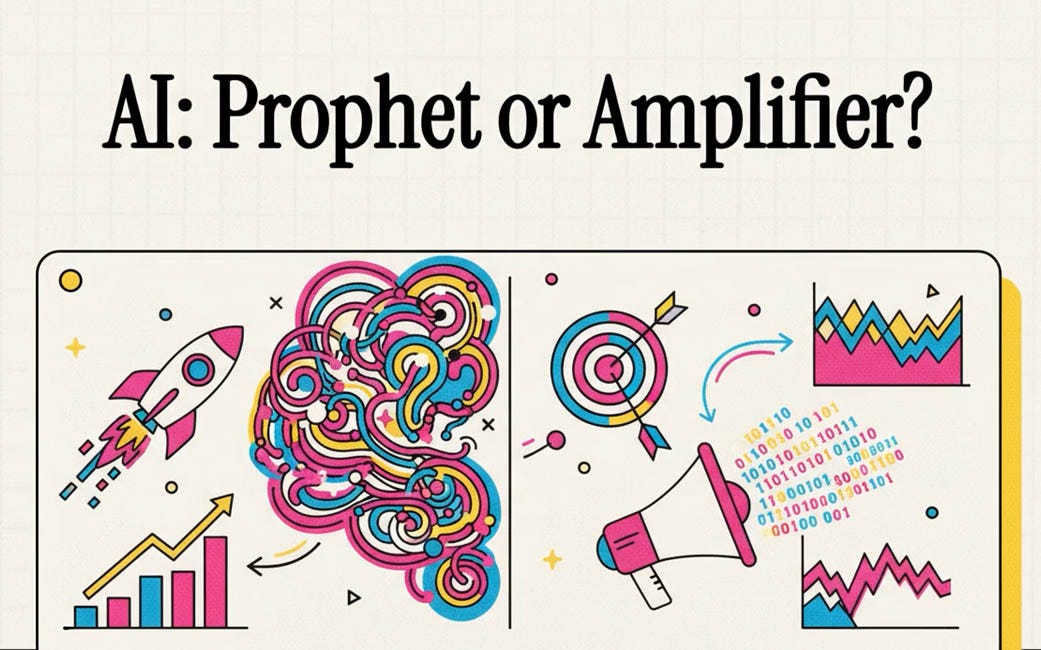
I need to say something that might be uncomfortable.
You can generate a full marketing campaign in about 45 minutes now. Copy. Images. Landing pages. Email sequences. Ad variations. All of it.
And here’s the part nobody wants to say out loud. It will look professional. It will sound competent.
And it will not work.
Not because the AI failed. Because the system underneath it was never aligned in the first place. You’re just running that misalignment at 100x speed now. With better production value.
The appeal is real. I get it.
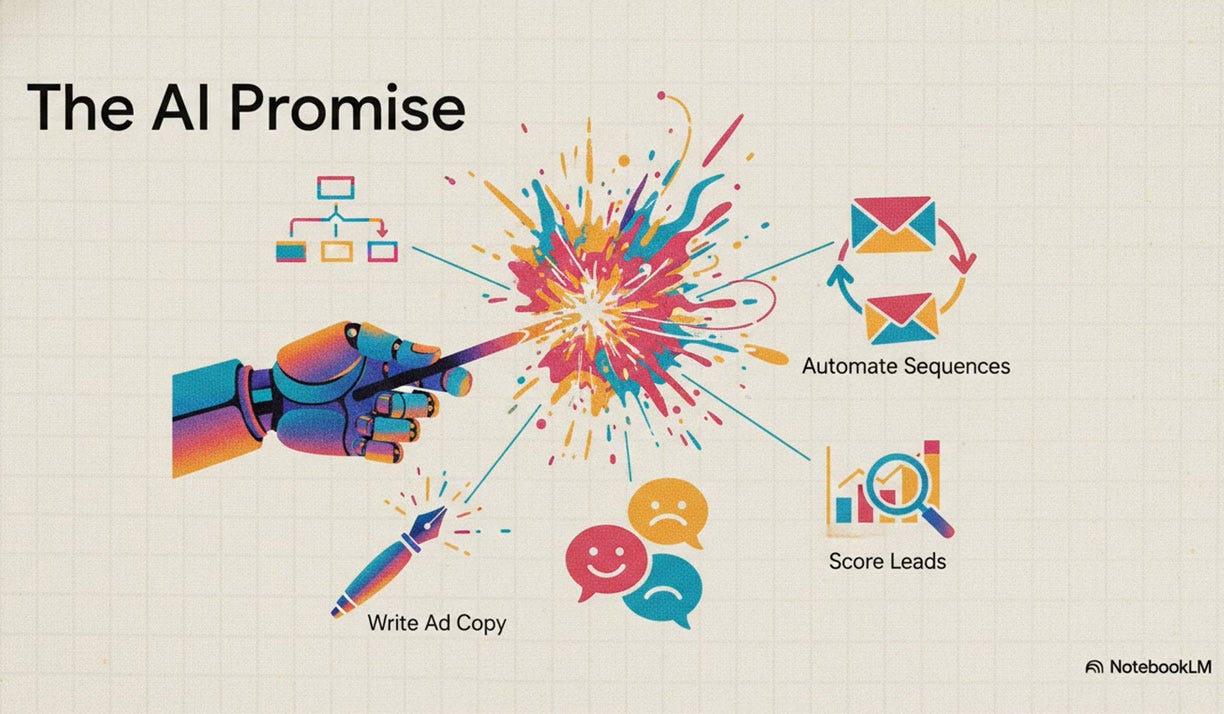
Look, if you’re a founder, a CEO, a marketing leader, the promise of AI is almost impossible to ignore. Not enough time. Not enough budget. Not enough people. And here comes this thing that says: I’ll write your ads. I’ll score your leads. I’ll personalize your emails. I’ll analyze thousands of customer comments in seconds.
It feels like the answer. I understand why people grab onto it.
But there’s a cost hiding behind that promise. And it doesn’t just add up. It compounds. Every quarter you lean on this without a foundation, the problem gets deeper and the price gets steeper.
Here’s the math most people skip.
AI is an extraordinary amplifier. But if your fundamental marketing system is broken, if you don’t actually know your customer’s internal reality, if your messaging says one thing on the website and something different in the sales deck, if your sales team is rewriting the pitch before every meeting because the marketing doesn’t match what they’re hearing in conversations. All AI does is help you do that wrong stuff faster.
You burn through money faster. But the emails look great.
The mirror problem
Most companies, probably without realizing it, are doing what we call Mirror Marketing. Their homepage says “We are...” Their ads say “Our product does...” Their decks lead with company history and awards. Their AI tools just polish that mirror until it gleams.
But the mirror is still pointed inward.
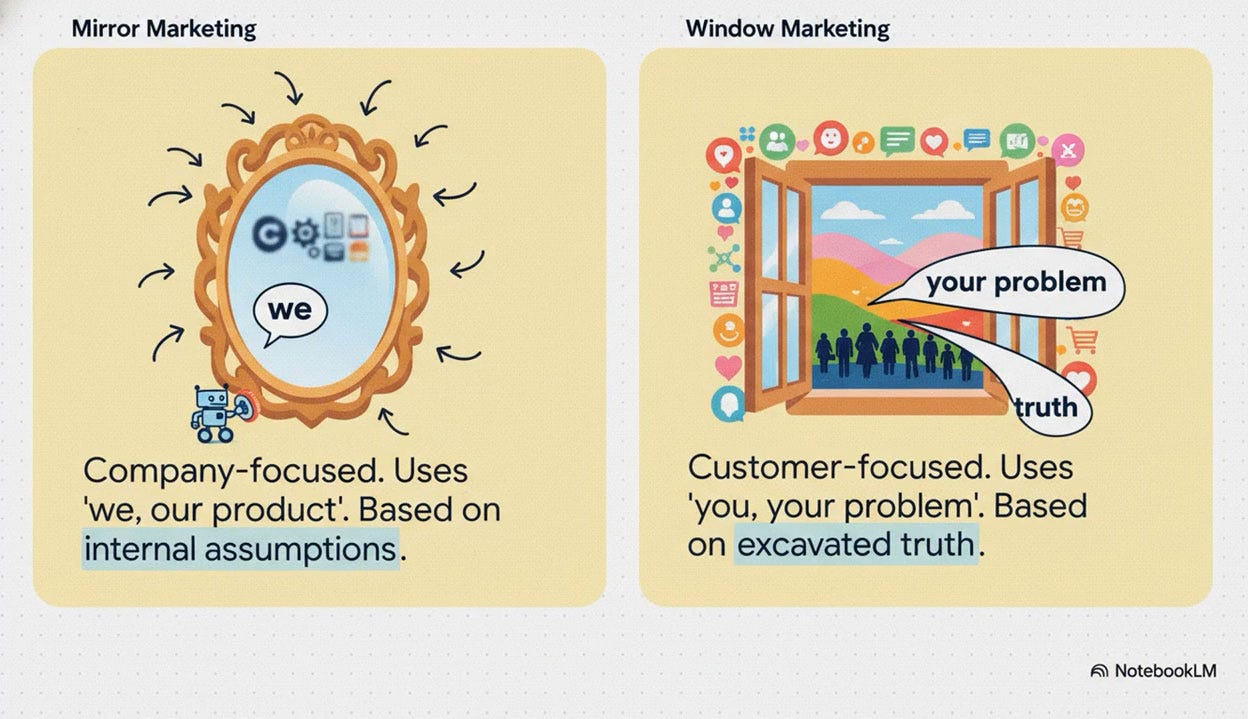
What actually moves cost curves without increasing spend is the opposite. Looking out at the customer’s world. Speaking to their reality. Their tension. Their language. Not yours.
AI doesn’t know the difference. It generates from the statistical average of everything in your category. And the average is exactly where revenue goes to die.
The Chaos Tax
Here’s something that changed how I think about this.
You probably know what you pay for a lead. You might know your close rate. But almost nobody I talk to knows what they pay for a lead that actually turns into revenue. Not a form fill. Not a demo request. A lead that becomes a customer.
The gap between those two numbers is what we call the Chaos Tax. It’s the most expensive line item that never shows up on your P&L.
And AI makes it worse. Not because AI is bad. Because AI is indifferent. It amplifies whatever system you give it. If the inputs are misaligned, wrong customer psychology, wrong narrative, wrong measurement infrastructure, AI just amplifies the misalignment. At scale. With perfect grammar.
So what does AI actually need?
Not a better prompt. A foundation. And the order matters because each layer depends on the one before it.
Psychology first. Understanding why people actually choose. Not features. Not price comparisons. Identity protection. Fear. Aspiration. The stuff that never shows up in your click-through data. AI gives you the average. Revenue lives in the specific.
I used to skip this step. I came from the data side. I wanted to go straight to what I could measure. It took me longer than I’d like to admit to understand that the measurable stuff only works when the psychology underneath it is right.
Then data. Not spreadsheet data. Excavated customer truth. The pause before someone names their real fear on a call. The tension between what a customer says they want and what their behavior reveals they need. AI can process volume and surface word frequency. It can’t hear what’s underneath the words.
Then story. And here’s the trap. You can generate an entire messaging framework in 20 minutes now. Mission, vision, value propositions, taglines. It’ll be grammatically flawless. Tonally appropriate. And completely interchangeable with your three closest competitors. Because AI generates from the average of all messaging in your category. If your brand story could have been written for anyone in your space, it’s not a story. It’s furniture.
Then community. AI can simulate warmth. It cannot generate belonging. Belonging requires risk. Vulnerability. The possibility of rejection. The most human company wins. And AI is not human. I resisted this idea for a long time. I’m a systems guy. But the data kept telling me the same thing. People buy from people they feel connected to. No algorithm changes that.
Then owned audience. AI makes it trivially easy to produce more content for social platforms. More posts. More videos. More carousels. Faster, cheaper, higher volume. And every piece of that content builds on someone else’s land. You’re producing more stuff, faster, on platforms you don’t control. Volume isn’t the problem. Ownership is the problem.
Then measurement. Closed-loop. Revenue-connected. Not dashboards that tell one story while the actual revenue tells a different one. AI is being used for lead scoring, automated follow-up, chatbot qualification. All useful if the definitions underneath are correct. But if your MQL definition is wrong, AI just scores wrong leads faster.
That’s the system. Psychology. Data. Story. Community. Audience. Measurement. In that order. Each layer protecting the one before it.
Remove any one and the others weaken.
The resolution
AI as a false prophet, this belief that tools can replace understanding, is the most expensive seduction in marketing right now.
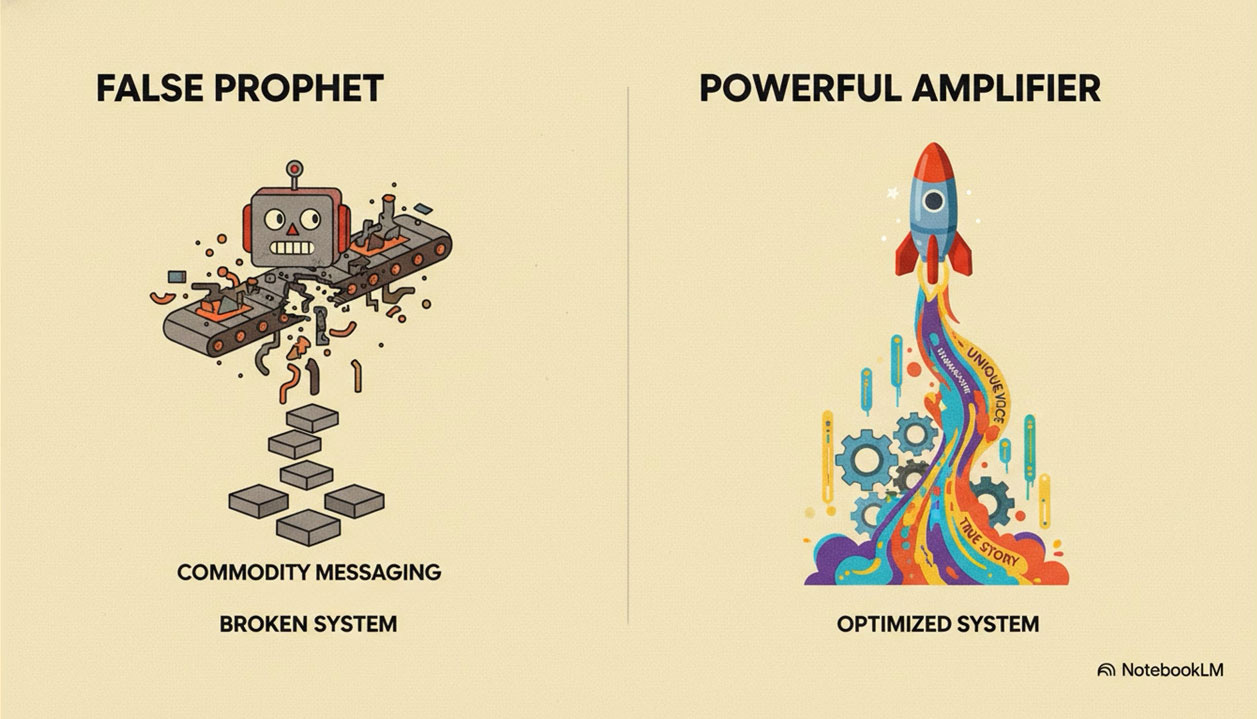
But AI as an amplifier, applied to a system that actually works? That’s where it gets genuinely powerful.
When the foundation exists, AI can:
Enforce your brand voice at scale. Because you’ve defined what your voice actually is. Through real excavation and real narrative architecture. Not a brainstorm on a whiteboard.
Generate content that sounds like you. Because constraints exist to prevent drift.
Accelerate research synthesis. Because you know what questions to ask before AI summarizes the answers.
Optimize campaigns faster. Because your measurement infrastructure captures the right data and feeds it back.
Personalize at scale. Because you’ve defined psychological clusters, not just demographics.
What AI cannot do:
Feel your customer’s identity tension.
Know what your customer is afraid to lose.
Build belonging.
Create the kind of human vulnerability that earns trust.
Replace lived experience with statistical probability.
Generate gravity from nothing.
AI is agnostic. The system determines the outcome.
If you amplify coherence, you get compounding growth. If you amplify incoherence, you get compounding waste. Same tool. Different results. The variable is what you built before you turned it on.
The question was never “should we use AI?”
The question was always: do we have a system worth amplifying?
Every quarter you operate without that system, the Chaos Tax compounds. Your CAC rises. Your messaging fragments. Your sales team drifts further from your marketing. Your AI tools amplify the incoherence and nobody can figure out why the numbers aren’t working because the dashboards all look fine.
It’s not a cliff. It’s a slope. And the slope gets steeper.
The tool is not the problem. The tool is not the solution.
The foundation is the whole conversation.
Coherence before creativity. Diagnosis before deployment. Meaning before media. Revenue before reach.
That’s the operating logic.
And no algorithm changes it.
Are you sure that what you’re amplifying is truly what you want to be known for? 🤔
Preach brother Curtis.