


Every conversation I’m in about AI advantage treats it like a tools problem.
Better prompts. Better models. Better workflows. Pick the right stack, wire it up right, and you pull ahead.
That’s the conversation. And it’s mostly wrong.
Your competitors have the same tools you do, and the same public data. NotebookLM, deep research, competitive analysis — none of it is yours, because all of it is theirs too. Anything every operator can buy or pull off the open internet can’t be the thing that sets you apart. When everyone can pull the same market intelligence in thirty seconds, the intelligence isn’t the moat. It’s the floor.
The moat is what they can’t get to. And the deepest part of it isn’t even the data. It’s the thing that produced the data.
Writing isn’t typing
My co-host Tom Nixon said something on the show this week that reframed the whole thing for me. We were talking about why generic AI content feels empty, and he stopped and made a distinction I haven’t been able to put down since.
Writing isn’t typing.
Writing is the thinking you do about the topic — for an hour, a week, ten years. That’s the writing. By the time you put it on pixels, that part’s just typing. Tom’s line was: keep the thinking to yourself, outsource the typing only.
Run that through the AI conversation and it turns the whole thing around. Most operators are racing to hand the AI more of the work. The whole pitch of the tools is that they’ll do the thinking and the typing both. Tom’s flipping it. The thinking is the only part that was ever yours. The typing was never the asset.
Which is why your conversations are the moat. Not because they’re transcripts nobody else has — though they are. Because they’re where your thinking already happened. The transcript is the residue of it. The decision you talked yourself into on a client call, the read you gave a deal in a debrief, the thing you finally said out loud in the last ten minutes of a two-hour session — that was the thinking. It already occurred. It’s sitting in the recording, waiting to be recovered.
What’s actually yours
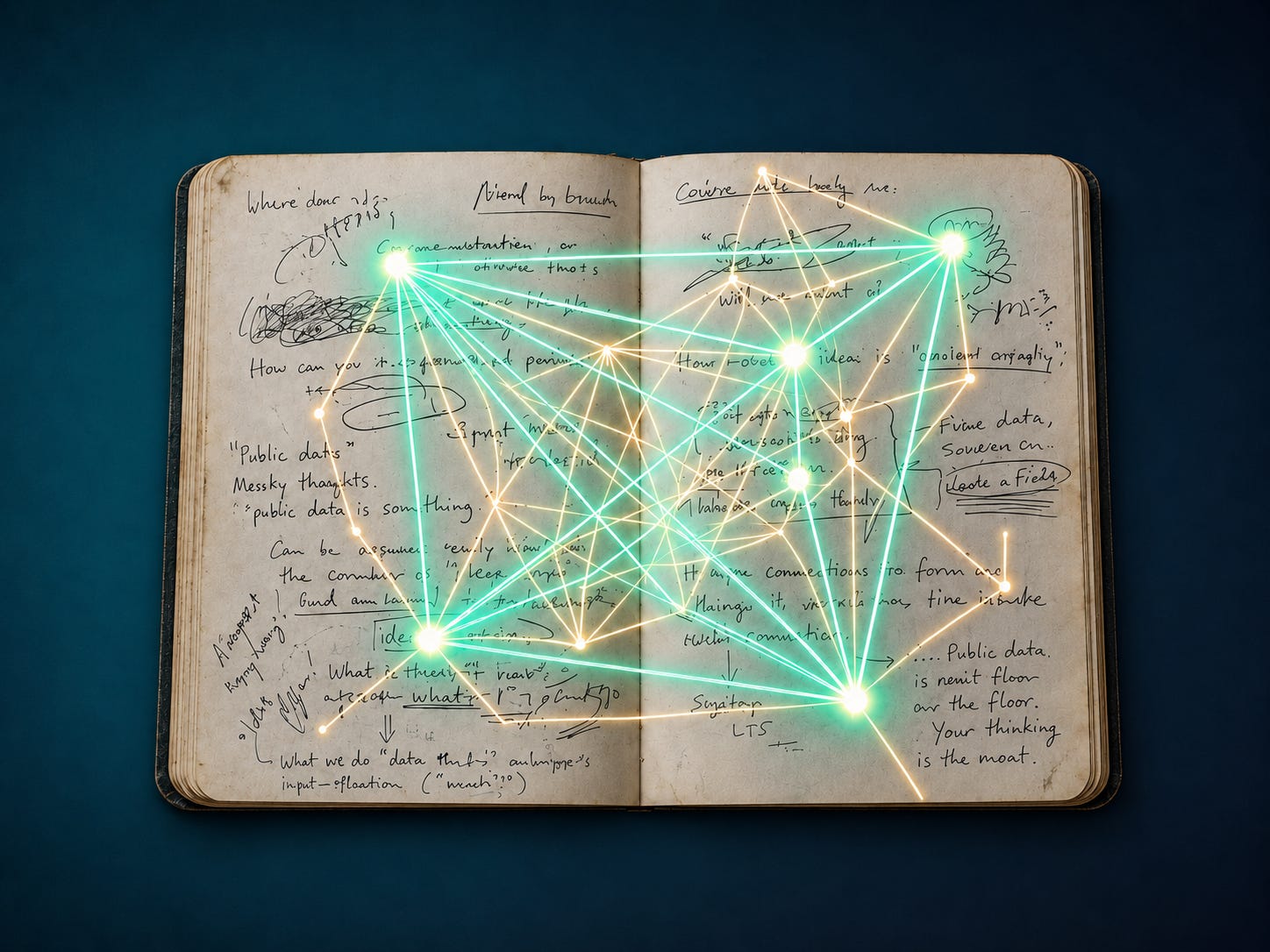
There’s a category of data that is completely asymmetric. Nobody else was in the room. Nobody else was on that call. Nobody else heard what your client said when they stopped performing and started being honest.
Your meeting transcripts. Your sales call recordings. Your client debrief notes. Your team’s voice memos after a hard engagement. The conversations you have in your day that exist nowhere else and belong to no one else.
I was guilty of not capturing this for years. I sat across from clients and listened well. I made good notes. I carried the insight in my head into the next session and used it. The problem is that anything I carried in my head died when I moved on. The thinking happened — and then it evaporated. It didn’t compound. It didn’t train anything. It didn’t travel. It was experience that stayed private instead of becoming infrastructure.
That’s the first category of asymmetric data. There’s a second: the thinkers whose work you’ve spent years taking in.
The thinkers you’ve actually metabolized
Your worldview isn’t only what you think. It’s the synthesis of the people you’ve genuinely absorbed.
Tom named this on the show too. Our doctrine isn’t just our own thirty years of opinions — it’s Mark Schaefer, Brian Clark, Gini Dietrich. People we’ve interviewed, read, argued with in our heads, and adopted philosophically until their thinking became part of how we see. We stand on the shoulders of giants. The difference now is we can capture which giants, and how we metabolized them, instead of letting it stay vague.
That’s asymmetric too. A competitor can read the same Schaefer book you read. They cannot reconstruct which ideas you took, which you rejected, and what you did with them inside your own work over a decade. That synthesis is yours. It’s another layer of human data nobody can scrape, because the scraping already happened — in your head, on your terms.
So the raw material of your doctrine is two things. The conversations you’ve had. And the thinkers you’ve truly absorbed. Both are residue of thinking. Both belong only to you.
What fills the vacuum if you don’t
Tom put this next to something every brand person already knows. Your company is going to have a culture whether or not you take an active part in creating it, documenting it, policing it. Walk away from it and one forms anyway — just not the one you’d have chosen.
AI is the same. If you don’t form the doctrine, you don’t get a blank system. You get one that fills the gap from somewhere else — the model’s training data, the conventions baked into every borrowed template, the internet’s averaged opinion of what an operator like you probably believes. The thinking still gets done. It just gets done for you, by a machine running on everyone’s defaults instead of your convictions.
That’s the actual choice. Not “build the moat or don’t.” It’s “do your own thinking, or inherit the average’s.” The vacuum doesn’t stay empty.
Underneath the summary
When operators do capture transcripts, they extract the surface. They ask the AI to summarize what was discussed. They pull the action items. That’s useful. It’s also the shallowest possible return on the data.
There’s a question underneath the summary. Not “what did this person say?” but “what does this person’s pattern of decisions tell me about what they actually believe?”
I work with a home care operator named Mario. The surface read on his transcripts was clear — census, referral sources, staffing ratios. Standard operational concerns. But the pattern across a dozen conversations told a different story. Every time a decision carried reputational risk, Mario slowed down. Every time a decision was defensible, even if the economics were softer, he moved faster. He consistently chose the option that reduced his exposure to being blamed, even when the better economic option was on the table.
Mario doesn’t decide based on upside. He decides based on downside protection.
That’s not in the summary. That’s in the pattern. And when I understood it, everything changed — the framing of options, the order I put choices in front of him, which risks I named first. You only see that if you ask the data the right question, and you only have the data if you captured the thinking instead of letting it evaporate.
Where to start
If this feels like a lot, the first move is older than any of the tools, and you can do it today.
Keep one notebook.
Not a system. Not an app with folders and tags and a filing structure you’ll spend a weekend setting up and never touch again. One book — paper if you like the feel of it, a single digital note if you don’t. Everything goes in the next blank space: the thought in the car, the line a client said that you can’t shake, the read you got on a deal, the half-idea you’d normally lose by lunch. No judging it on the way in. No deciding whether it’s a good idea or a bad one before it lands on the page. The friction of “where does this go?” is what kills the habit — so it goes nowhere except the next open spot.
Two rules hold it together.
No to-do lists. The notebook is for thinking, not for getting things done. The minute you let tasks in, they crowd out the part that matters and the book becomes another inbox. Keep the chores on a scrap you throw away.
And review it constantly. This is the whole engine — not study, not memorization, just flipping back through it in line at the coffee shop, on the couch, between calls. That’s where it pays off. Ideas you wrote down weeks apart start to touch each other. A read you had on a client in March turns out to explain a pattern you spotted in June. The connections don’t live in any single entry. They surface when you keep passing back over the whole thing, and you only get to keep doing that because none of it evaporated.
This isn’t a productivity hack someone invented last year. It’s the commonplace book — the same practice behind Da Vinci’s six thousand pages, behind Darwin and Mark Twain. Da Vinci wrote a line at the start of one of his own that the artist Perry Daniels, who keeps the habit today and calls it the Grail Method, saved into his: “this is to be a collection without order, taken from many papers which I have copied here, hoping to arrange them later each in its place.” That’s the permission. It doesn’t have to be tidy to be the most valuable thing you keep.
One honest tension, because Daniels names it and I’m not going to dodge it: he’s against the structured second-brain — the Notion database, the elaborate filing system. And he’s right about the failure he’s pointing at. When structure becomes the place ideas go to die — sorted into folders so clean you never open them again — it kills exactly the connection-making the notebook is for. The structure earns its keep only when it does the opposite: when it helps you retrieve and collide what you captured, instead of burying it. The notebook is the raw, unsorted layer. The structure, if you add one, is just there to let you pass back over more of it than your hands could ever flip through.
Because that’s the move underneath all of this. Once you’ve got the corpus — the notebook, or the year of transcripts and voice memos behind it — you don’t ask it for a summary. A summary plays back what you already know. You ask it for the pattern across everything. The Mario read didn’t come from one call. It came from a dozen, asked the right question. Same one I ran on my own conversations before I ever pointed it at a client — I loaded my own calls and debriefs and made the AI mine me, and it handed back my worldview clearer than I’d have written it cold.
The Grail Diary
If you want to do that at scale, I built the thing I wished I’d had for years. It’s called the Grail Diary — the commonplace book, rebuilt so a machine keeps it with you. One notebook. Everything goes in the next blank space, no judging it at the door, no to-do lists allowed in. What the machine adds isn’t a verdict — it’s reach. It reads back over more of the corpus than your hands could ever flip through and lays the pieces out in front of you: here’s the line from March, here’s the one from June, here’s the read you gave that deal. It surfaces; you connect. It will not tell you what your pattern means, on purpose — the moment a machine names your belief for you, you’ve handed back the one part that was yours. Naming it is still your move. The mining I described above — pointing the AI at the whole pile and asking for the pattern, not the summary — runs on one discipline: when a pattern and a thing you said about yourself disagree, trust the pattern, and never let it hand you a belief you didn’t demonstrate. Empty beats fabricated, every time. I’m putting the Diary out in the open for anyone who wants it. Reach out to me if you’d like to try it. But you don’t need it to start. You need the notebook and the habit of reading back over it.
Public data is what everyone has. The conversations in your day, and the thinkers you’ve actually absorbed, are what nobody else can get to. That gap is the moat.
The thinking was always the asset. The only question is whether you’re keeping it — or letting the machine do it for you.
If this landed, two places to go deeper:
The conversations behind this thinking — [Bullhorns & Bullseyes]
The operators working through it live — Clief Notes
Join Tom and Curtis Friday at 10:00 AM EST, we host a live session for the real questions — the ones you don’t put in a DM. No deck. No agenda. 30–45 minutes of straight answers from two people who’ve spent years inside marketing and IT. — Join us at The Watering Hole