

You chose the more expensive option and you can’t fully explain why.
You post-rationalized it with features you haven’t even used yet. The decision just felt right. Good, even. And yet as a provider, you’re still writing feature comparison charts and making bold performance claims. Your customer is acting exactly like you did—and you’re ignoring it.
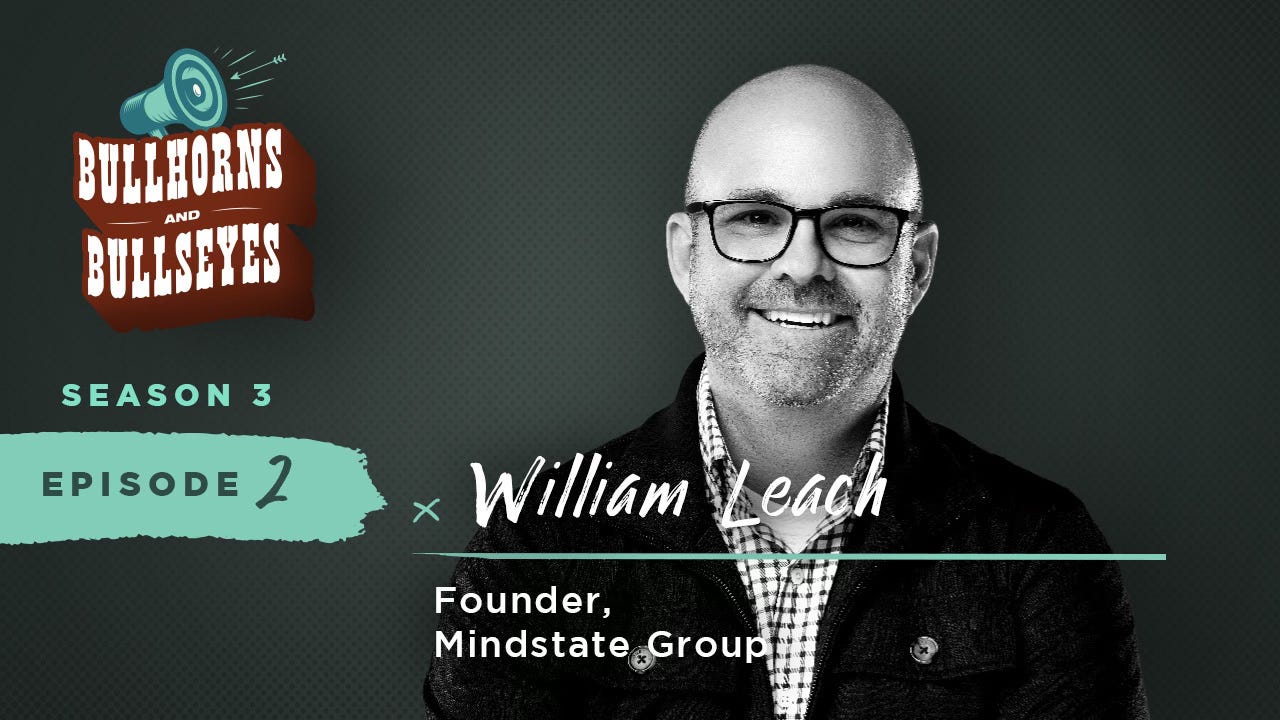
That’s the disconnect Will Leach came back to Bullhorns and Bullseyes to explain.
The Subconscious Decides What Is Bought…and When
Will wrote the book—literally—on marketing to mind states. His research shows that the vast majority of human decisions are made at the subconscious level. If your marketing isn’t speaking to the subconscious, it will always be less effective.
Not sometimes. Always.
The reason most marketers resist this isn’t because they don’t believe it. Most of them, when pressed, will nod and say, yes, of course, emotion plays a role.
The problem is what gets measured. And what gets measured gets done.
About a decade ago, marketing became accountable for revenue delivery. If you can see it in a dashboard—cost per lead, click-through rate, conversions—it gets funded.
What can’t be easily measured is the deep psychological understanding of your customer. So that’s what gets cut.
As Will pointed out, even he didn’t get it fully right on his own book cover by his own admission. The subtitle reads: A Practical Guide to Applying Behavioral Design to Research and Marketing. That’s a feature. Nothing emotional in it. The expert wrote a feature list about the importance of not writing feature lists.
So we all do it. It’s natural to do it. Comfortable, even. But here’s how to undo it going forward.
The Tells Are There—If You Know What to Look For
One of the things Will pushed back on in the episode is the assumption that psychological mind states are invisible. They’re expressed, he said. We just don’t know how to read them.
Think of it like poker. When customers talk—in reviews, in call transcripts, on social media—there are tells. Words they choose. The way they frame a problem. What they lead with versus what they bury. AI can actually help surface these patterns at scale. Will is doing exactly that: running client call transcripts through AI trained on his behavioral framework to identify which mind states are showing up in the data.
Curtis brought a real example: a client with 16,600 phone calls from last year. They ran those transcripts through AI and found common themes that are now shaping the positioning strategy for this year. That’s not replacing the human interview. That’s using the data you already have.
But Will was clear: AI will never ever catch the quiver in someone’s voice. He’s been in the room when someone broke down crying in a closet during a customer interview. That’s the best insight he’s ever gotten. No transcript will capture it.
The Reticular Activating System
There’s a mechanism in the brain called the RAS: the Reticular Activating System. It sits at the base of the brain and acts as a filter, constantly sorting billions of pieces of incoming stimuli based on what’s relevant to your current goals and fears. If your marketing doesn’t speak to those goals or fears, it doesn’t make it through the filter. It doesn’t matter how well-produced the ad is. It won’t register.
This is why understanding the “bleeding neck problem” matters. Not the product spec. Not the differentiator. The specific pain that, if left unaddressed, is going to cause real damage. When you speak to that, you get through the filter. When you don’t, you’re invisible no matter how loud you turn up the volume.
Will’s homework for listeners: before any marketing meeting, start by asking what is the customer’s pain or aspiration right now? If you can’t answer that, stop the meeting.
Tom added his own: go to your homepage and look at the copy above the fold. If the subject of the first sentence is your company—we, our, the business name—you’re in Mirror Marketing territory.
Brand is Your Moat.
Before the episode wrapped, Will shared a conversation he’d had with a former CMO of 7-Eleven. The debate in the room was whether AI agents would make brands irrelevant—agents talking to agents, humans removed from purchase decisions.
Will’s take was the opposite. Brand will be the moat. Not operations, not distribution, not pricing. The thing that LLMs will recognize and trust. The one asset that survives commoditization.
Curtis tied it back to the season’s thesis: if you know your brand context deeply and put it into AI, AI works for you. If you don’t, it amplifies your drift.
Gradually, then suddenly.
What If You Had a Crystal Ball?
It comes down to this: What if you knew exactly WHY your next prospect would be highly motivated to buy from you? And when? And why they wouldn’t?
And what if that prospect told you exactly what they needed to hear in order to be convinced that you were the product of service of choice?
What if you could see into their subconscious and read both their minds and their movitations—to know the emotional impulse at the core of their decision to make a purchase?
What would you do with that information?
Next week, Emily Bielak is going to return to the podcast to show you how to get it.
👉 Watch or Listen to Season 3, Episode 2 here.
Available on YouTube, Apple Podcasts, Spotify, and everywhere you listen.
Bullhorns & Bullseyes is hosted by Curtis Hays and Tom Nixon. Season 3 drops a new episode every two weeks.
Will Leach was so insightful during this conversation. Love the way his mind works!