

Your competitor just announced they’re “AI-powered.”
New tools. New workflows. New vendor. LinkedIn post about it with a rocket emoji.
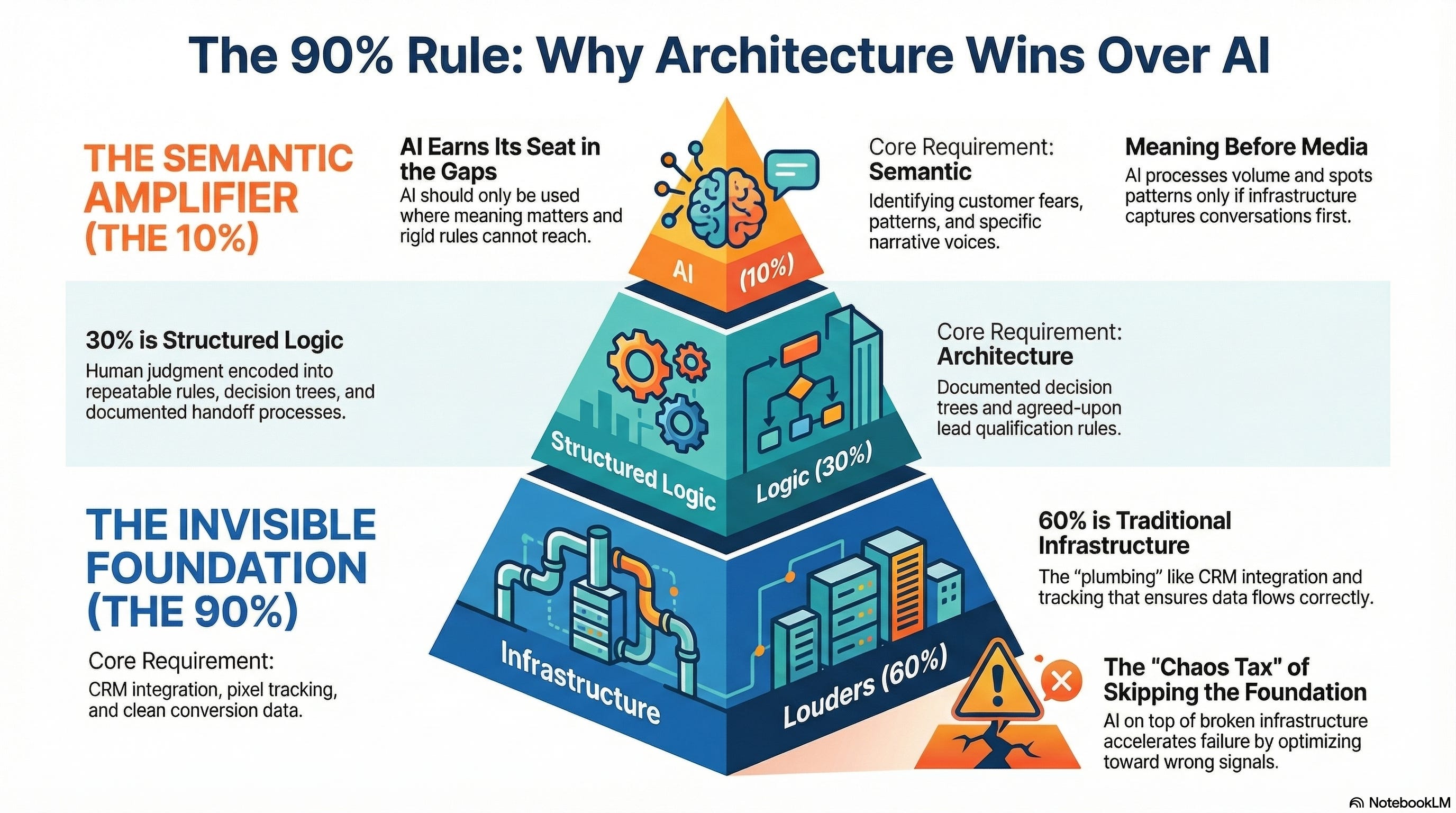
And here’s the thing. In about nine months, their numbers are going to look exactly the same. Maybe worse. Because the part they invested in — the AI — is about 10% of what actually makes a system work.
The other 90% is boring. It’s infrastructure. Logic. Rules. Plumbing that nobody posts about because it doesn’t sound like the future.
But it is.
I’ve been thinking about this since I wrote about AI being an amplifier, not a prophet. That piece was about what happens when you turn AI loose on a broken system. It amplifies the break.
This piece is about what’s underneath the amplifier. What the system actually needs to look like before AI earns its seat.
The Pattern That Keeps Showing Up
I’ve been watching something across our clients and across every implementation I study that actually produces results. The same ratio keeps appearing.
Then I came across Jake Van Clief’s work on what he calls Computational Orchestration, and I realized he’d put a name to something we’d been doing for years without articulating it.
Jake’s research shows a 60/30/10 pattern in every successful AI implementation he’s built or observed. And when I mapped it against how we actually build client systems, it was nearly exact.
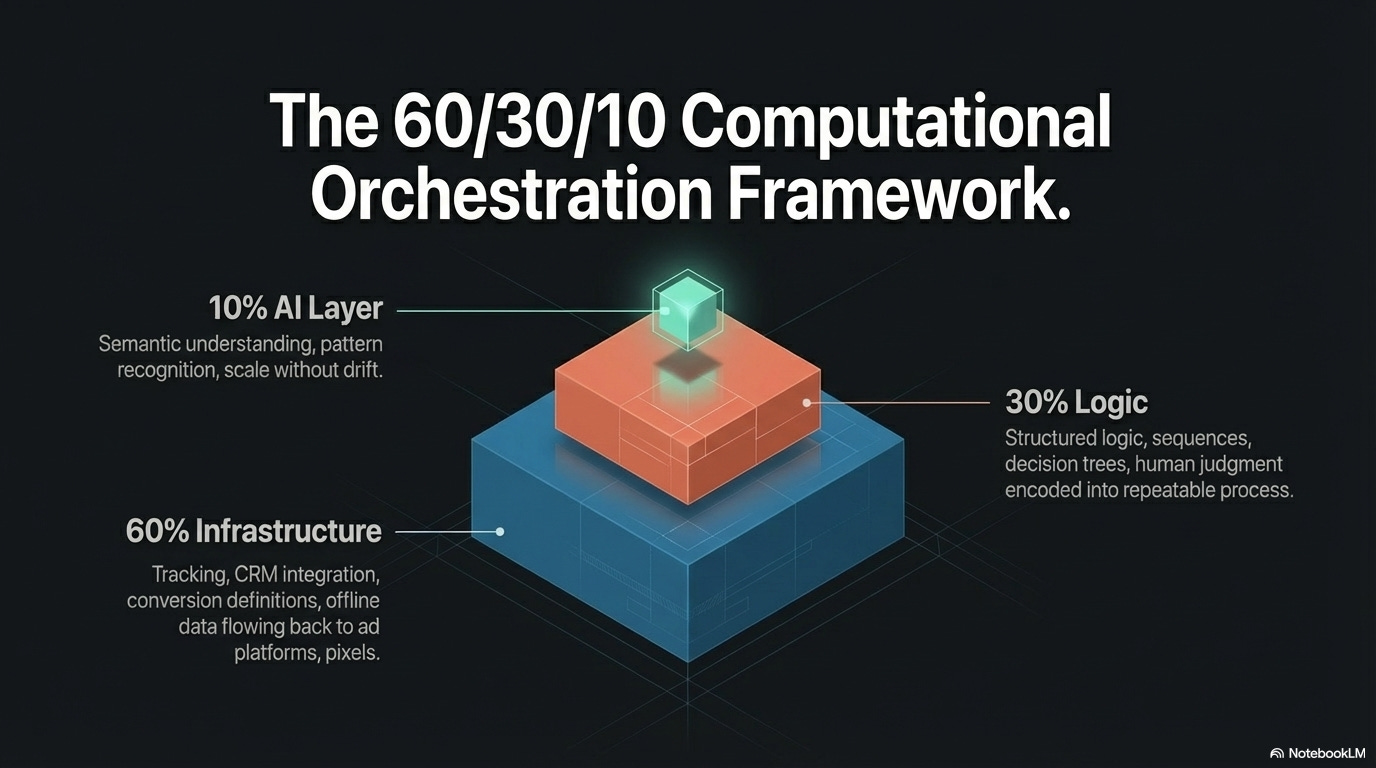
About 60% of what works is traditional infrastructure. Tracking. CRM integration. Conversion definitions. Offline conversion data flowing back to the ad platforms. Pixels firing correctly. The forms actually routing to the right person.
None of that is AI. It’s plumbing. And when it’s broken, nothing downstream works. Not your campaigns. Not your lead scoring. Not your AI-powered anything.
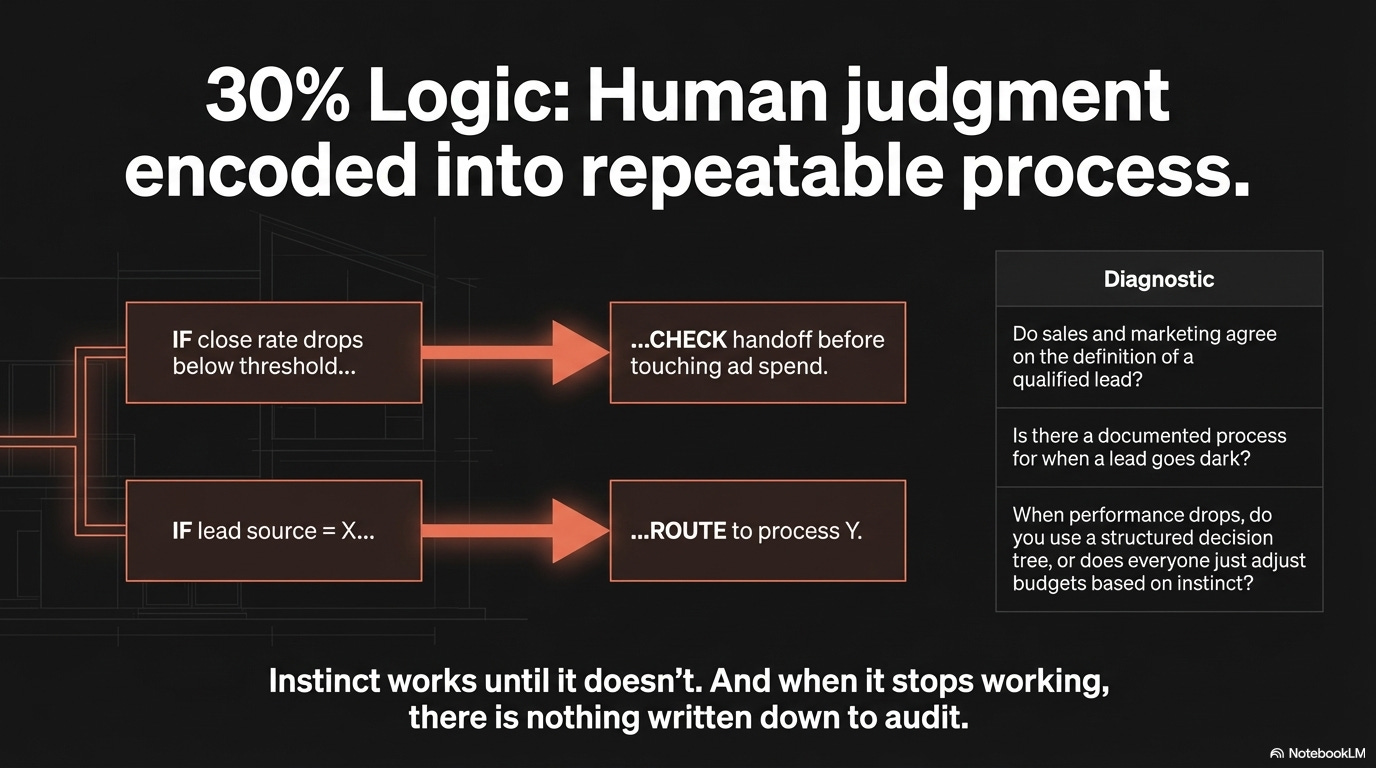
Another 30% is structured logic. Rules. Sequences. Decision trees. If a lead comes from this source, route it here. If the close rate drops below this threshold, check the handoff before touching the ad spend. If your sales team is rewriting the pitch before every meeting, the problem isn’t the rep — it’s that marketing made a promise the sales conversation can’t keep.
That’s not AI either. That’s architecture. Human judgment encoded into repeatable process.
The remaining 10% — maybe — is where AI actually belongs. What Jake calls the semantic layer. The part that requires understanding meaning, not just executing rules.
Reading a customer call transcript and finding the fear underneath the words. Identifying the identity tension that’s actually driving a purchase decision. Generating content that carries a specific voice because the constraints that define that voice already exist.
The 10% makes the system feel like it understands you.
The 90% makes the system actually work.
We didn’t learn this from Jake. We’d been building systems this way since before we had language for it. But his framework gave the pattern a name. And once something has a name, you can teach it. You can audit against it. You can stop having the same argument about whether AI is the strategy or the tool.
Why This Ratio Makes People Uncomfortable
It’s not a compelling pitch. Nobody raises a round on “we built a really solid CRM integration.” Nobody gets promoted for saying “I spent three months making sure our conversion definitions match between marketing and sales.”
But that’s where the money is.
Every company I’ve worked with that has a rising cost per acquisition and can’t explain why — the answer is in the 90%. Not the 10%.
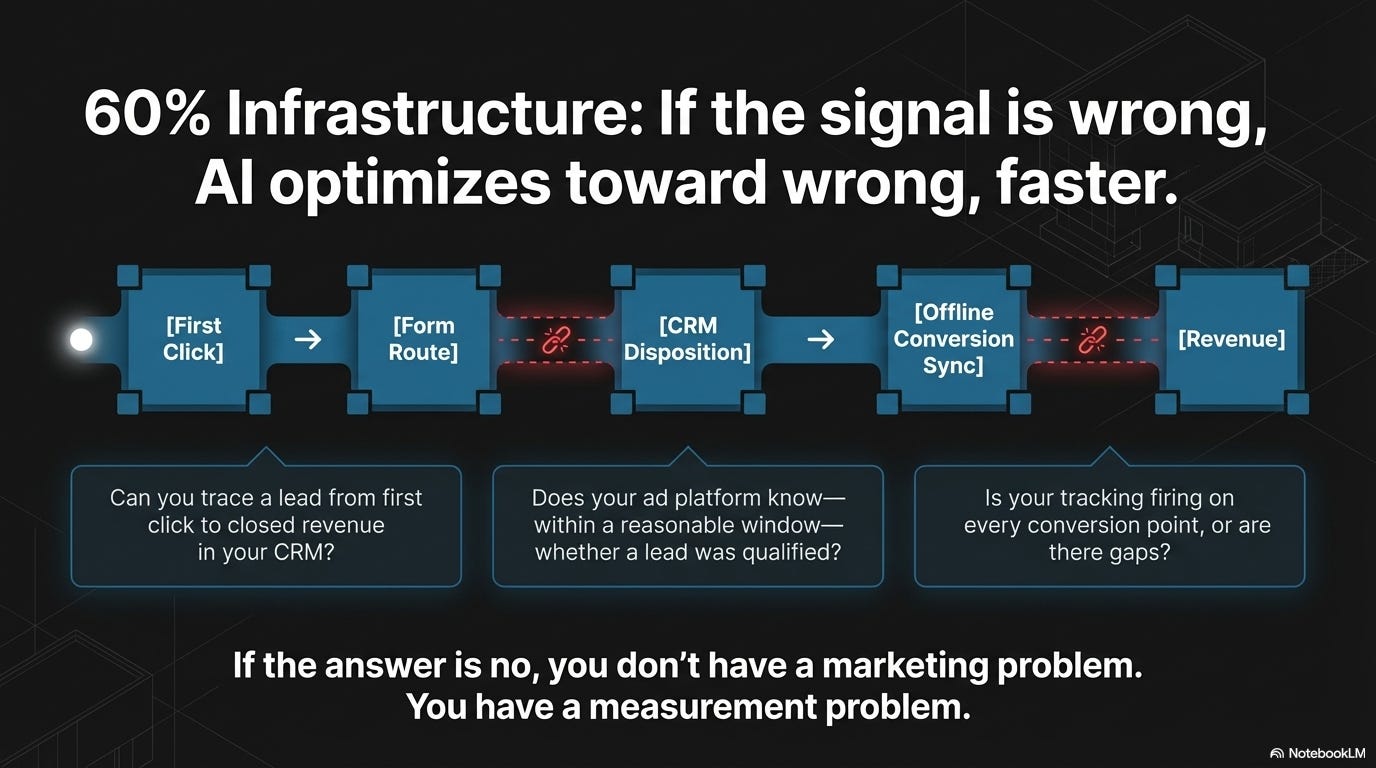
The tracking is incomplete, so the ad platform is optimizing toward the wrong signal. The CRM isn’t feeding disposition data back, so marketing has no idea which leads actually became revenue. The sales qualification definitions were written two years ago and nobody updated them when the product changed.
AI doesn’t fix any of that. AI makes all of it faster.
If the signal going in is wrong, AI optimizes toward wrong faster. With better grammar. In more channels. At scale.
That’s not a technology failure. That’s an architecture failure wearing a technology costume.
Where AI Actually Earns Its Place
I’m not against AI. I use it every day. But I’ve learned — slower than I’d like to admit — that AI earns its seat only in the gaps where meaning matters and rules can’t reach.
When you need to hear what a customer is actually afraid of, not just what they said on the form. AI can process volume and surface patterns a human would miss. But only if the infrastructure capturing those conversations exists first.
When you need content that sounds like a specific human being wrote it. AI can generate at that level — but only if the voice definition, the guardrails, the narrative rules are already built. Without those constraints, AI generates from the average. And the average is where every brand sounds interchangeable.
When you need to spot the moment a system starts drifting. AI can monitor for narrative inconsistency across channels, flag when the promise on the ad no longer matches the promise on the landing page. But only if someone defined what consistency means first.
Pattern recognition. Semantic interpretation. Scale without drift.
That’s the 10%. And it’s genuinely powerful — inside a system that’s already doing the other 90% right.
The Question This Raises
If 90% of what makes marketing work has nothing to do with AI, then what are you actually buying when you hire an “AI-powered” agency?
If the answer is “we use AI to write your ads and score your leads” — you’re buying the 10% without the 90% that makes it matter.
If the answer is “we build the infrastructure, install the logic, close the feedback loops, and then apply AI only where semantic understanding is required” — that’s a system. That’s what compounds.
The companies getting this right don’t lead with the AI. They lead with the architecture. The AI is the last thing they add. Not because it’s unimportant. Because it depends on everything beneath it.
The Real Cost of Skipping the 90%
Every quarter you run AI on top of broken infrastructure, the Chaos Tax compounds. Your cost per acquisition rises and nobody can explain why because the dashboards look fine. Your sales team drifts further from your marketing because the handoff was never defined in the system. Your content gets produced faster but says less because there were no constraints to hold the voice in place.
It’s not a cliff. It’s a slope. And AI makes the slope steeper because it accelerates whatever direction you’re already headed.
Coherence or incoherence. Compounding or decay. Same tool. Different foundation.
The 60/30/10 Test
Here’s a diagnostic you can run on your own system right now.
The 60% check — Infrastructure:
Can you trace a lead from first click to closed revenue in your CRM? If someone fills out a form or calls the office today, does your ad platform know — within a reasonable window — whether that lead was qualified? Is your tracking firing on every conversion point, or are there gaps you’ve been meaning to fix?
If the answer to any of those is no, you don’t have a marketing problem. You have a measurement problem. And no amount of AI fixes a measurement problem.
The 30% check — Logic:
Do your sales and marketing teams agree on what a qualified lead looks like? Is there a documented process for what happens when a lead goes dark? When performance drops, does your team have a structured decision tree — is it targeting, offer, story, or handoff — or does everyone just start adjusting budget?
If those rules don’t exist, you’re running on instinct. Instinct works until it doesn’t. And when it stops working, nobody can diagnose why because there’s nothing written down to audit.
The 10% check — AI:
Is AI being applied to problems that require semantic understanding? Or is it being used to automate things that a spreadsheet formula or a simple integration could handle?
If your AI is doing work that doesn’t require understanding meaning — it’s expensive automation. Not intelligence.
The foundation is still the whole conversation
Last time, I wrote that the question was never “should we use AI?” It was “do we have a system worth amplifying?”
This is the next layer of that argument. The system worth amplifying is mostly invisible. It’s infrastructure and logic and rules and definitions that nobody writes LinkedIn posts about.
AI sits on top. Thin. Powerful. But dependent.
The companies that will win the next five years aren’t the ones with the best AI. They’re the ones with the best 90%.
Diagnosis before deployment.
Meaning before media.
Coherince before creativity.
Revenue before reach.
The plumbing is the strategy.
