

If a proposal adds AEO or GEO to your monthly bill, the first question is what it adds to the SEO you already pay for. AEO is answer engine optimization. GEO is generative engine optimization. Both mean work aimed at getting your business mentioned in answers from tools like ChatGPT, Perplexity, and Gemini.
Prospects ask me whether I sell it. Clients ask me too. In October, we pulled 12 months of analytics from 36 businesses we work with to see what AI tools send them. Two items have since been reported: a Google test and an OpenAI beta. Each has its own section below.
Now get the answers from a leading authority on acronyms (and more!)
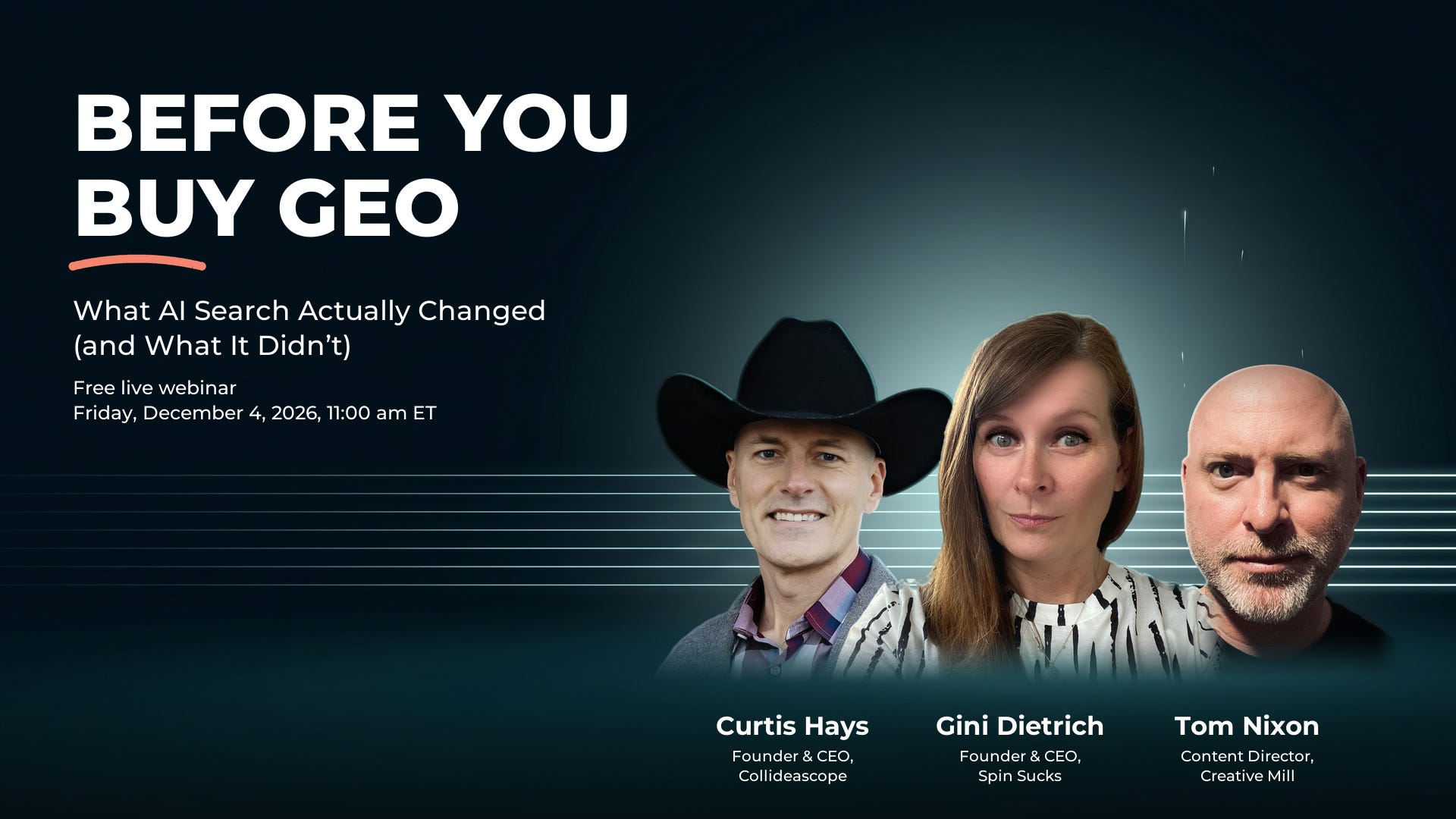
On December 4, We’re hosting a free webinar on what AI search has changed, what it hasn’t, and what to check before you buy.
Before You Buy GEO: What AI Search Actually Changed (and What It Didn’t) Friday, December 4, 2026, 11:00 am ET. 60 minutes, live on Riverside, a live-video platform. Free. Registration takes a first name, last name, and email.
The agenda: what has changed in search and what hasn’t; where leads come from; getting found across AI platforms; what to do now and what to ignore; and the questions to ask a vendor before you buy. I open with the 36-business analytics.
The expert: Gini Dietrich, Founder & CEO of Spin Sucks and creator of the PESO Model, covers the model, a framework for paid, earned, shared, and owned media.
The moderator, Tom Nixon, Content Director at Creative Mill and my co-host on Bullhorns and Bullseyes, moderates the panel on what to do now. Questions close the hour.
The webinar is for anyone who wants a fee checked before it is approved. It is not for anyone who wants the order taken unexamined.
Register here: https://collideascope.co/webinar/
What AI tools sent 36 businesses
The analytics cover October 22, 2025 through October 21, 2026. Sites where Google Analytics records online purchases were grouped together. The four content, app, and platform sites were grouped together based on our judgment. Every other site counts as lead generation. We compared visits from ChatGPT, Perplexity, Gemini, Copilot, and claude.ai with visits from Google organic search, the Google results you don’t pay for.
The 24 lead generation sites received about 1 AI visit for every 58 from Google organic search.
The 8 online purchase sites received about 1 for every 49.
The 4 content, app, and platform sites received about 1 AI visit for every 33.
Across all 36 businesses, it was about 1 AI visit for every 46. Total visits pool that figure: 68,162 from AI tools against 3,142,856 from Google organic search, so it is not an average of the three group figures.
These are visits, not customers, and we didn’t trace them through to sales.
Google Analytics counts clicks from Google’s own AI answers as organic search: AI Overviews, the AI summaries at the top of results, and AI Mode, Google’s chat-style AI search. Those sit in the Google number, not the AI number. The AI number also counts clicks only. Some AI research may end in a branded search on Google or a phone call, and neither shows up as an AI visit. The AI number runs below the true figure.
The article AEO and GEO Are Still SEO has the counts and method.
Google is testing an AI local result without the buttons.
When you search for a business near you on a phone, Google shows a local pack: a short list of businesses on a map, usually with buttons to call, visit the website, and get directions. The traditional version lists three businesses, so it is called a 3-pack.
On November 10, 2026, Search Engine Roundtable reported that Google is testing an AI Overview version of the local pack with the action buttons, reviews, and photos removed. Joy Hawkins posted on X that she had been seeing it for a few days: “On mobile, every time I get this version, the traditional local pack is gone.” Barry Schwartz, who wrote the report, said he could replicate it. The report includes no statement from Google and doesn’t say how many people see this version. It is a test.
Two older sources add context, three findings in all. Each uses a different method, and none measures the November 10 test.
A study of results. Smallbiz Edge ran 2,580 Google results on mobile across 172 keywords, 41 business types, and 15 cities, two of them outside the U.S. A Call button showed in 510 of them (19.8%). The study counts results, not businesses. Its page gives no date, and Search Engine Roundtable covered it on March 17, 2026, so it predates the November 10 test. The page says Google constantly tests and changes what it shows in search results, and Search Engine Roundtable’s write-up noted that the study draws on only 172 keywords.
An observation of law firms. Sterling Sky, using data from Jepto, looked at 179 Google Business Profiles, the listings that show a business in Google Search and Maps, across 34 U.S. law firms. Click-to-call declined over the two years before the post’s October 26, 2026 date, while website clicks from those profiles did not show the same decline. The post shows the size of the drop only in charts. These are law firms, and the data shows click-to-call declining without explaining why.
A dataset. In the same post, Sterling Sky compared AI local packs with traditional 3-packs in its recent ranking reports. AI local packs featured 5,943 unique businesses and 3-packs featured 18,330, about 32% as many. The post gives no dates for the comparison, and it counts businesses shown, not calls or clicks.
In the Business Profile report, Google defines Calls as “The number of times a customer clicked on the call button on your Business Profile.” Someone who finds your number another way is not counted. Because the number counts button clicks only, a falling Calls number does not, by itself, mean fewer phone calls. A search result can also hide the Call button while the profile still lists the right phone number.
Two checks look at different things. The first comes from outside research and is untested. The second is the comparison I use with call data.
Profile or layout. This check looks at whether your phone number is missing from your full Business Profile or only from the search layout. Open the full profile and the search result.
Calls against your own counts. This check compares the Calls number in your Business Profile report with the calls your call tracking records (a service that logs which source each call came from) and with the leads in your customer relationship management (CRM) system.
For six of our local clients, our tracking over the same 12 months recorded calls and form fills. Phone calls were the majority of tracked leads at five of the six. Those counts are approximate.
Businesses in ChatGPT
OpenAI announced Businesses in ChatGPT on November 10, 2026. Businesses can now claim their listings and submit or correct information, but OpenAI still controls what appears in ChatGPT. Claiming a listing doesn’t guarantee your business will show up.
I covered it in the November 13 issue, “Claim your business in ChatGPT.”
What to check before you buy
A Google local result and a ChatGPT listing are both places outside your website where a customer can find your business.
Before: announcements and proposals, and no record of where you stand. After: two baselines, which are numbers written down now to compare against later. The first is AI visits next to visits from Google organic search. The second is your Calls number next to your own call counts. The first shows how many visits AI tools send your site today. The second shows how the Calls number compares with the calls you record today. A new fee can then be checked against your close rate, the share of leads that become customers, and your cost to win a customer.
Diagnosis before deployment.
Send whoever is pitching the fee three questions:
What does this buy that the SEO we already pay for doesn’t cover? Please name the deliverables.
What result does it have to produce, and how will we measure it?
When do we review it, and what number does it have to hit for us to keep going?
Hold the approval until the first one has an answer in writing.
The webinar, a closing offer
Don’t miss ▶️ Before You Buy GEO: What AI Search Actually Changed (and What It Didn’t)
Friday, December 4, 2026, 11:00 am ET. 60 minutes, live on Riverside.
Free. Registration requires a name and an email.
Register here: https://collideascope.co/webinar/
Asking what AEO or GEO adds to the SEO a client already pays for is the right filter, Curtis, and the 36-business analytics sound like the evidence most proposals skip.
Look forward to seeing you all at the webinar! Gini is sure to bring the goods!