


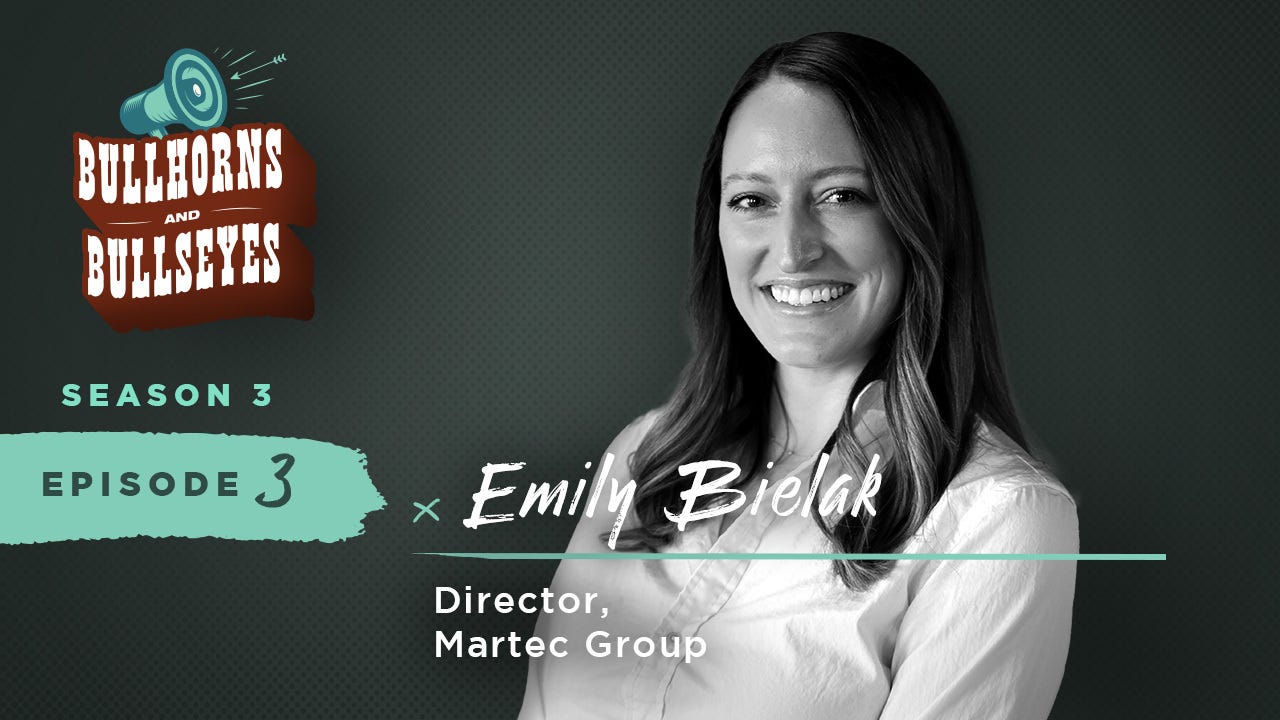
The most dangerous sentence in business is not, We don’t know need to know our customer.
It’s: We already do.
That’s what I said at the top of this episode, and I meant it. Because the second sentence closes the door. The first sentence at least leaves it open.
Emily Bielak came back to Bullhorns and Bullseyes this season to talk about what happens when you actually go find out what you don’t know — and, more importantly, what to do with it when you have it.
Research that Sits in a Filing Cabinet Tells No One
Curtis started the episode with a business owner he’d been sitting across from recently. The owner had a two-step process to acquire customers. Step one: qualify them. Step two: convert them. The qualification rate was improving. The conversion rate wasn’t. And the owner was deep into pricing strategy and discount structures trying to fix it.
Curtis’s question: When did you last talk to a customer? Not survey them. Talk to them.
Emily’s answer to why that question gets resisted so often: emotions are perceived as fluffy. Okay, we know how they feel. What does that mean for revenue?
So the Martec Group built a way to quantify it: The Martec Emotion Score.
It works like NPS: measure the net level of pleasantness of emotion, track it across segments, across journey stages, compare it to competitors. Now it’s a metric, not a feeling. Now the CFO can engage with it.
But the number is only half of it. The other half is the so what and the now what.
Emily laid out the framework: What, So What?, Now What?.
Step one is what you heard: 60% of people feel happy at this stage.
Step two is what it means: So, what’s the implication?
And step three is what you do: Now what? How do you move that number to 75%?
That last step is where most research dies. Someone hands the client a data dump, calls it done, and moves on. The research sits. Nothing changes.
Segments, not Monoliths
One of the things Emily pushed on hardest was the tendency to treat all customers as one thing. Leaders who say “we know our customer” are usually thinking of one customer—their ideal customer…the 10 % of their customer base that fits the perfect profile. And they’re thinking of that customer at the point of purchase, which is the end of the journey—a destination, not the journey itself.
Real segmentation surfaces complexity that a single ideal client persona (ICP) misses. Emily gave an example from a barbecue brand they worked with. The ICP was less than 10% of the population they studied. The other 90%—some buying only sauces, not seasonings, some in adjacent segments that could be captured with the right product or message—were invisible.
The kicker: different segments going through the exact same process can have completely different emotional journeys. Being put on a wait list might be deeply frustrating for one segment and completely neutral for another. You can’t design for that if you’re only thinking about your ideal customer.
Peak-End Theory
Tom brought up Peak-End Theory—the principle that how people remember an experience boils down to how they felt at its peak moment and how they felt at the end.
Emily’s example from her own life: Machu Picchu. The peak was walking through the gates. The end was a 12-hour flight delay sleeping in the airport. Years later, those are still the two things she remembers: the extraordinary high and the miserable close.
Apply that to a business. A prospect comes in at peak anxiety. The neck is bleeding, they need help, the business owner is brilliant at meeting them there, calming the room, and handing them off. Then the sales process takes over. It introduces complexity. Features. Layers of information. And the close rate is terrible.
Tom named it directly: the peak was calm and reassurance. The end was complexity and fear of the unknown. Those two things don’t match. The research shows you where the journey breaks. The execution is just fixing the break.
The OODA Loop
Curtis brought in a framework he uses from military aviation: Observe, Orient, Decide, Act. Developed by a Top Gun instructor for fighter pilots making split-second decisions in combat. Observe the data, orient yourself around what it means, decide what to do, act. And then loop back.
The part Curtis emphasized was the act. Someone has to be accountable for the decision that gets made. And the loop means you come back to the numbers to see what actually happened after the decision was implemented. Research without a loop is just a snapshot.
How often do you need to do this?
Curtis asked the practical question: with everything changing this fast, how often does a company need to revisit customer research?
Emily’s answer: minimum viable is customer interviews every year—five, ten, or more depending on your customer base. Just someone who isn’t the main point of contact asking real questions about what’s going on. It’s free to do and almost nobody does it.
The fuller version—a qual>>quant>>qual segmentation study—Emily would recommend you revisit every three to five years, or sooner, if the market gets disrupted. Qual interviews to surface context. A statistically significant survey, at least 800 respondents for segmentation. Then qual again to bring the segments to life.
She made one other point that landed. For the business owner who says they can’t afford this: If you’re spending $120,000 a year in marketing and 50% of it is misaligned with what actually drives your customers’ decisions, that’s $60,000 wasted. The research isn’t a cost. It’s an investment that makes the spend worth deploying.
Check Out Season 3, Episode 3
Available on YouTube, Apple Podcasts, Spotify, and everywhere you listen:
https://bullhornsandbullseyes.substack.com/podcast
Bullhorns & Bullseyes is hosted by Curtis Hays and Tom Nixon. Season 3 drops a new episode every two weeks.


